
Asset management companies are entrusted with millions and even billions in client assets, playing a vital role in the global financial ecosystem. But with that trust comes immense responsibility.
As the industry evolves and faces increasing regulatory scrutiny, asset management companies must recognize that they are not immune to the risks of financial crime – particularly money laundering. Trust is the foundation of the client relationship in asset management, but it is also one of the industry’s most fragile assets. Once broken, it can take years to rebuild – if at all. The Deutsche Bank “mirror trading” scandal, in which clients used stock trades to covertly transfer over USD 10 billion out of Russia, serves as a cautionary tale.
In this blog article, we will explore the unique AML risks facing asset management firms, how trust and compliance go hand-in-hand, and what companies must do to strengthen their defences in an increasingly complex financial environment.
Different Types of Asset Management Companies
The financial services landscape in the last decade is undergoing a seismic transformation as traditional asset management firms face mounting competition from a new wave of challengers. Neobanks (e.g., Revolut), family offices, and wealth tech companies (e.g., Robinhood) are reshaping client expectations with agile platforms, personalized offerings, and digital-first strategies. These emerging players are not only encroaching on market share but also redefining the standards of accessibility, transparency, and customization in financial management. As investors, from retail to Ultra High Net Worth (UHNW) Individuals, demand more control, lower fees, and better user experiences, legacy asset managers are being forced to adapt or risk obsolescence.
| Player Type | Differentiator | Strenghts | Impact on Industry |
|---|---|---|---|
| Neobanks | Seamless digital banking + integrated investing | - Low fees - Mobile-first UX - Unified banking & investing | Attracting younger, tech-savvy clients with convenience over legacy relationships |
| Family Offices | Ultra-personalized, holistic wealth services | - Generational planning - Flexible asset allocation - Independent advice | Winning UHNW clients seeking discretion, privacy, and bespoke solutions |
| Wealth Tech Companies | Scalable, tech-driven platforms with automation | - Robo-advisors - Low costs - AI-powered personalization | Disrupting pricing models; forcing incumbents to digitize and simplify offerings |
| Traditional Asset Managers | Incumbent expertise with broad product offerings | - Investment depth - Brand trust - Global infrastructure | Challenged by faster, cheaper, more agile players |
While asset managers play a critical role in optimizing investment returns and stewarding wealth for institutions and individuals alike, they also operate in an environment rife with regulatory scrutiny. One of the most pressing concerns today is the threat of money laundering – a risk that, if overlooked, can expose firms to severe legal, reputational, and financial consequences.
In this blog article, we will explore the unique AML risks facing the asset management sector, why these risks are intensifying, and how firms can implement robust compliance frameworks to protect themselves and their clients.
The Importance of Trust
Trust is the cornerstone of the relationship between an asset management company and its customers, and it must operate in both directions to be truly effective. Clients entrust asset managers with their wealth, expecting not only strong financial stewardship but also transparency, confidentiality, and ethical conduct. Before the right asset manager is selected, they are conducting (or should do) their own checks that we can call Know Your Asset Manager. In return, asset managers rely on clients to provide accurate and complete information, particularly when it comes to verifying identities, sources of funds/wealth, and investment intentions. This mutual trust is essential for building long-term relationships, ensuring compliance with regulatory obligations, and preventing misuse of services for illicit purposes. When trust is established and maintained, it enhances cooperation, reduces friction in due diligence processes, and supports the shared goal of preserving and growing wealth responsibly.
However, not all factors can be taken into account and certain blind spots and risks cannot be eliminated. The recent example in Lithuania and the Baltcap company is a great example of it when the former partner Šarūnas Stepukonis may have misappropriated over EUR 42 million, with more than EUR 36 million reportedly lost to gambling in casinos in Lithuania and Estonia. Even if Know Your Portfolio Manager checks were done, you cannot always account for additional factors, such as the Portfolio Manager’s addictions (at least without the help of a private investigator).
Are you an asset management company interested in screening of sanctioned persons? Check out the Customer Screening module from AMLYZE.
Key AML Risk Factors in Asset Management Company
From the first glance the asset management industry does not appear to carry a high risk for Terrorism Financing, but the picture is different for Money Laundering crimes as asset management companies are particularly vulnerable to money laundering due to their global reach, high-value transactions, and often business clients with complex ownership structures.
The key risks depend on existing business model. Below are some examples what risk factors asset management firms should be aware of:
Client Anonymity and Complex Structures – High-net-worth individuals and institutional clients often use trusts, shell companies, or offshore vehicles to manage wealth. These structures can obscure beneficial ownership, making it difficult to identify the true Source of Funds (SOF) or Source of Wealth (SOW). Tracing the origin of funds can be challenging, especially when documentation is limited or when clients resist full disclosure for privacy reasons. Also, the risk profile for such customers can differ a lot – from a person who inherited their wealth to a corrupt foreign politically exposed person or sanctioned oligarch.
According to the EU’s Supranational Risk Assessment 2022 report, asset management companies are not easy to access, therefore criminal organisations usually abstain from carrying out investment activities themselves, which makes the role of money laundering facilitators essential for both creating and utilising opaque structures to hide the proceeds of criminal activities.
Cross-Border Transactions – Asset managers routinely engage in international transactions across jurisdictions with varying levels of AML/CFT regulation. This creates exposure to countries with weak controls, secrecy laws, or high corruption levels. When looking at this area it is important to look not only at movement of funds, but also movement of securities, for example the simultaneous purchase, transfer and sale of securities across jurisdictions by two seemingly unrelated, but mutually controlled, entities.
Third-Party Distribution Channels – the use of intermediaries, such as fund distributors or private banks, can distance asset managers from the end client, increasing the risk when proper due diligence is not conducted by the third-party. If these third parties have weak or inconsistent AML controls—or operate in jurisdictions with lax regulations—they can serve as conduits for laundering activities without the asset manager’s knowledge. Relying too heavily on distributors to perform Know Your Customer (KYC) and transaction monitoring without adequate oversight or audit mechanisms can expose the asset management firm to serious regulatory, financial, and reputational consequences.
Movement of Funds Between Accounts – frequent and/or large movements of money in and out of investment funds may be a red flag for money laundering activities if there no clear or logical explanation, therefore asset managers must ensure that transactions are properly monitored. For example, the customer often sends money to his brokerage account and almost immediately withdraws the same/similar amount without buying or trading any assets to another bank account where the incoming funds appear as profits from investment activities when in reality the asset manager is being used in a layering scheme.
Complexity of the Products – asset management products are often complex by design, offering a wide range of instruments such as mutual funds, hedge funds, private equity, derivatives, and structured products. While these products serve legitimate purposes like diversification, tax efficiency, and risk management, use of a single (or multiple products) can also create opportunities for being misused. For example, in January 2021, a short squeeze of the stock of the American video game retailer GameStop and other securities took place, causing major financial consequences for certain hedge funds and large losses for short sellers. Approximately 140 percent of GameStop’s public float had been sold short, and the rush to buy shares to cover those positions as the price rose caused it to rise even further.

Inadequate Customer Due Diligence (CDD) – failure to conduct effective Customer Due Diligence (CDD) procedures or ongoing monitoring can leave firms blind to changes in client risk profiles or suspicious behaviour. The EU SNRA 2022 report mentions that this sector experiences significant conflict of interest between concerns over potential money laundering and the need to attract customers, some with a high money laundering risk profile, such as (foreign) politically exposed persons, customers from high-risk non-EU countries and high-income customers. Also, in the investment field, the client manager has a vested interest in conducting the business relationship (reward/salary), and this may reduce incentives to carry out rigorous customer due diligence.
Nevertheless, it is important to note that the main factor that mitigates the inherent risk of money laundering for this industry is the low level of cash-based transactions, despite the fact that the sector is exposed to high-risk customers. To have access to the investment sector, perpetrators need to introduce money through the banking system, and hiding illegal money through opaque structures requires a high degree of expertise and/or high cost. Therefore, banks are often a first barrier that mitigates the inherent money laundering risk as asset managers rely on banks to apply customer due diligence and monitoring when money enters bank accounts. But reliance is not a control, therefore incoming payments should not be ignored completely.
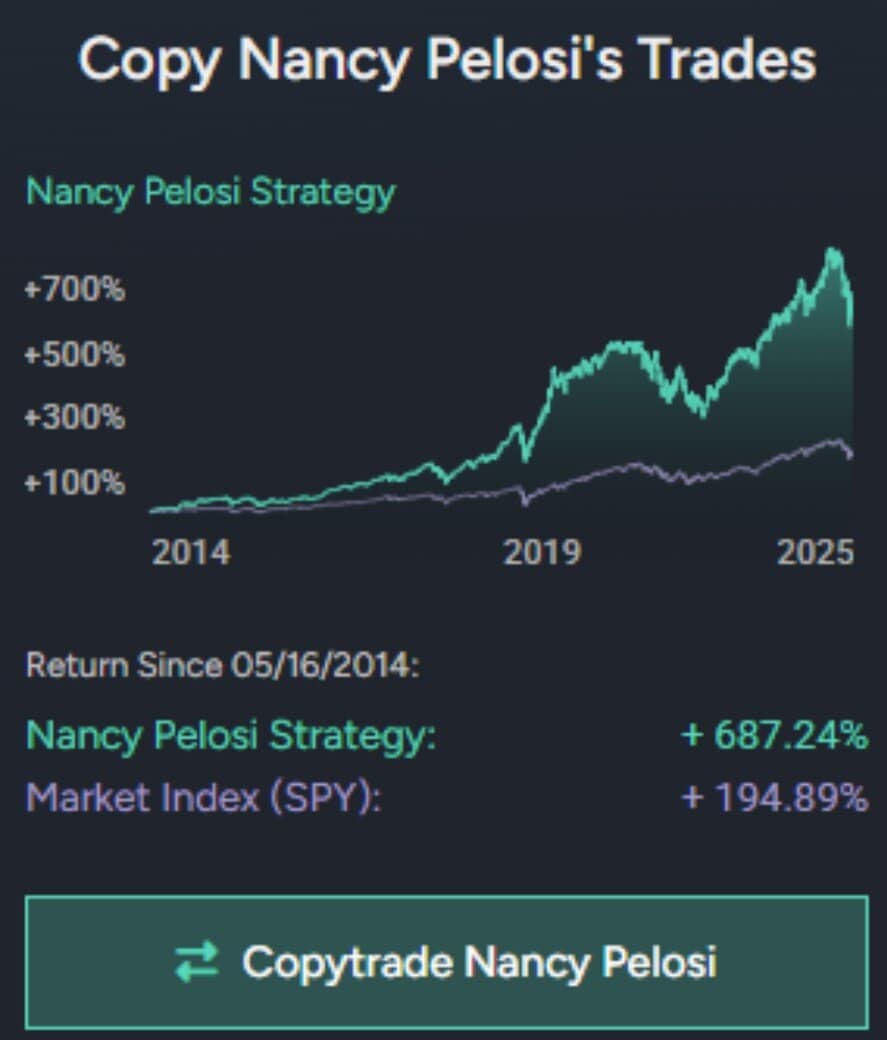
Market Abuse – asset management firms face significant money laundering risks stemming from market abuses such as insider trading and market manipulation. These illicit activities can generate substantial illegal profits not only for criminals but for legit employees that work with sensitive information (e.g., government agency or inside a company that has its shares publicly listed in the stock exchange). For example, The STOCK (Stop Trading on Congressional Knowledge) Act was signed into law in 2012 which prohibits members of Congress (and certain related individuals) from using information gathered through their position for personal benefit. Even with such laws in place, there are multiple websites that offer copy-trading services related to politicians that potentially could be related to insider trading. The picture below shows the trading outcome for Nancy Pelosi that constantly beats the market index. Not bad return for 84 years old person with a full-time job.
Limited Compliance Resources – a small, under-resourced and/or inexperienced compliance team that does not recognize the real risk exposure within an asset management company can be a significant risk factor for money laundering and other financial crimes that leads towards insufficient customer oversight and eventually to compliance breaches and regulatory penalties.
Are you an asset management company interested in client risk scoring? Check out the Customer Risk Assessment module from AMLYZE.
How Can Asset Management Companies Have Robust AML program?
While there is no single checklist that fits perfectly for all companies, starting with these elements is a good starting point:
Customer Due Diligence (CDD) Controls – conduct comprehensive customer risk assessments to identify exposure based on products, clients, geographies, and distribution channels. Conduct Customer Screening in order to identify if the client could be a politically exposed person, sanctioned individual or could have other Adverse Media. Use Risk-Based Approach (RBA) and allocate more resources proportionally to higher-risk areas and, if needed, conduct Enhanced Due Diligence (EDD) checks. Time is money and automation plays a vital role in this business. Also, don’t forget to periodically review client accounts and risk profiles to identify changes over time.
Have Proper Compliance Systems & Tools in Place – use automated tools for Customer Due Diligence (CDD) process and rule-based systems to detect suspicious activity, such as unusual movement of funds or transactions inconsistent with client profiles. What is more, establish clear procedures for identifying, escalating, and reporting suspicious activity within the company.
Governance and Accountability – clear internal ownership of AML compliance needs to be ensured, ideally through a dedicated Money Laundering Reporting Officer (MLRO) and a well-resourced compliance team.
Training and Awareness – provide regular, role-specific AML training to staff, including front-office teams, to maintain vigilance and ensure understanding of red flags and reporting procedures. Also, don’t forget to train yourself.
Deploy Third-Party Oversight Controls – assess and monitor distributors, fund platforms, and intermediaries to ensure their AML controls meet the firm’s standards. Establish contractual obligations for compliance.
Don’t Let Your Guard Down – stay current with evolving AML laws and regulatory expectations across jurisdictions and update policies and systems accordingly.