An account used to receive the proceeds of fraud usually has a short life. That single fact explains more about inbound fraud than any typology. It also explains why the institution best placed to stop the money has the least reason to: it pays the whole cost of stopping it and bears almost none of the loss (at least for now).
This is the first of four articles on the economics of fighting fraud on instant payment rails. It follows regulatory analysis, PSD2 vs PSR: what actually changes for payment fraud, which looked at how the forthcoming PSR redraws fraud prevention: beyond Strong Customer Authentication, towards transaction monitoring on both sides of the payment, information sharing between PSPs and greater responsibility across the payment chain.
This series takes the next step. If fraud prevention is no longer primarily about authenticating the payer, where in the payment chain can fraud actually be stopped most effectively? What does intervention cost, and who bears that cost? SCA remains important: it helps establish that the person using the credentials is the person entitled to use them. But that is precisely why it cannot solve every form of fraud. As it is pointed out in AMLYZE article in a scam, the customer may be deceived first and authenticate second. The authentication succeeds because the customer really did approve the payment; the fraud happened before the authentication began.
That shifts attention from the authentication event to the payment itself – and to both ends of it. Stolen money has to land somewhere. Usually, it lands in an account at another payment institution. That account may belong to a genuine, verified customer acting as a money mule, knowingly or unknowingly. In other cases, it may have been opened using false or synthetic identity information that passed onboarding controls.
This is where the regulatory and economic questions start to meet. The PSR increasingly treats the receiving institution as part of the fraud-prevention architecture. The economic question is whether the receiving side is also where some fraud controls can produce the greatest value – and at what cost.
The business that needs shutting down
Fraud on instant rails works like a small manufacturing business. It buys equipment, meaning accounts opened by recruited members of the public or set up on fabricated identities; it runs stolen money through that equipment; and it replaces the equipment when it breaks. Most policy questions worth asking turn out to be questions about what that business pays.
The account is a piece of equipment with a purchase price, an operating cost, a yield and a working life. What it is not is a fixed asset that can be amortised over a long period. It gets consumed in a single use, or a few. It works until the first fraud report reaches the beneficiary institution holding it, or until that institution spots the behaviour itself, and then it is closed for good. Closing on the first substantiated report is ordinary practice across the sector for accounts opened for natural persons, though it may not be the case for business accounts.
The quantity that matters is therefore the value pushed through one account life inside the reporting lag, meaning the time between the fraudulent credit arriving and the account being stopped, whether that stop comes from an external event such as a fraud report or a recall, or an internal one such as an investigation triggered by the institution’s own controls. What instant settlement changed is throughput: more transactions and more value crammed into that window, exploiting institutions that cannot act quickly enough. The length of that window is critical, and part 3 of this series discusses it in detail.
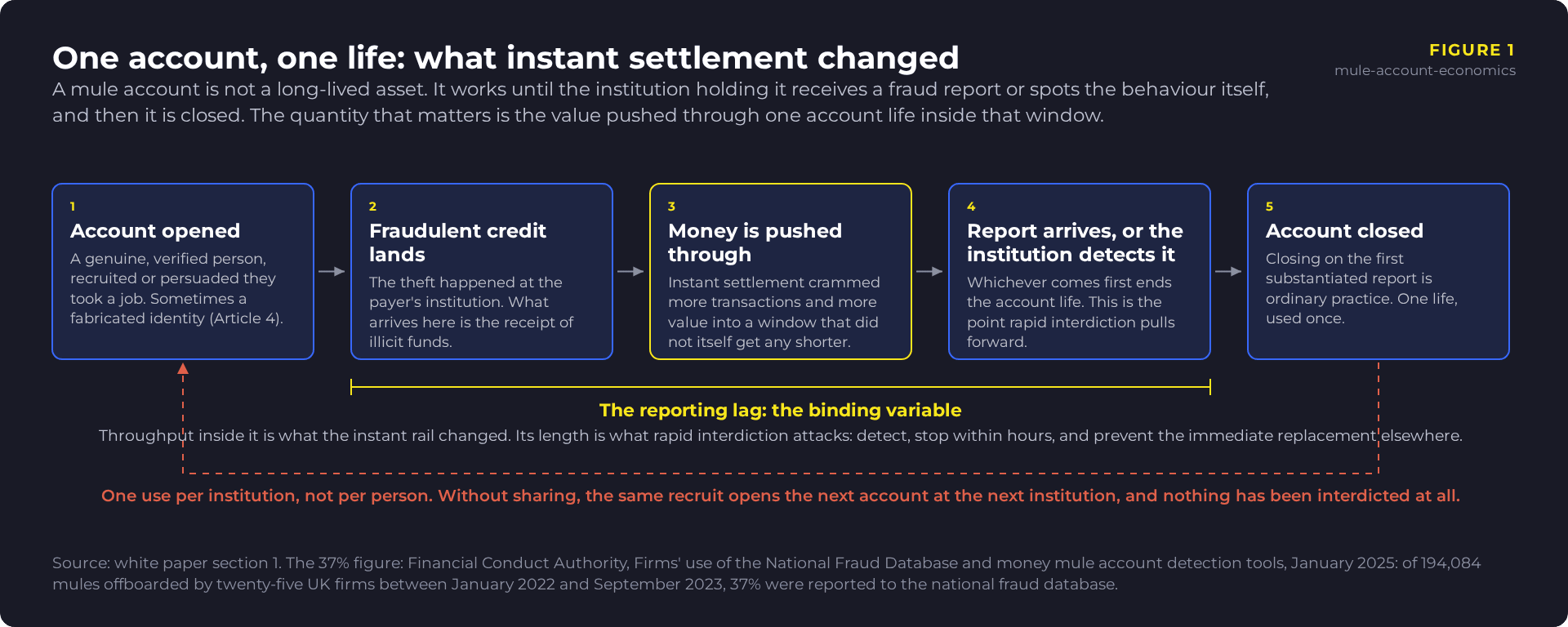 Figure 1. One account, one life. A mule account works until a fraud report arrives or the institution detects the behaviour, and then it is closed. Instant settlement changed how much value fits inside that window, not the length of the window. The 37% figure cited in the chart is from the Financial Conduct Authority, Firms’ use of the National Fraud Database and money mule account detection tools, January 2025.
One use per institution, with many institutions to choose from
Here is the consequence that matters most, and it is the most actionable finding in the whole series. The account, or rather the identity behind it, is used once per institution, and there are many institutions around, each of which multiplies the opportunity. Absent any sharing of identity information, a recruited person or a fake identity is not one account. They are one account at every institution that will open one for them.
A worked example makes the arithmetic concrete. Take a recruit who is paid EUR 50 for the use of an account. If that recruit can open accounts at five institutions before anyone connects the openings, the criminal gets five account lives for one recruitment fee: EUR 10 per usable account life. If, instead, the first closure is shared and the other four institutions block or restrict the same identity, the criminal gets one life for the same EUR 50. Same person, same price, five times the cost per usable account. That is what the phrase “price of an account life” means: what the criminal pays for one usable account, which is the recruitment price divided by the number of institutions the same recruit can be used at.
Sharing therefore works on the criminal’s costs in two ways at once. It ends the remaining lives of the same identity at every other participating institution, so one recruit yields one life rather than several, which is the multiplier in the example: threefold across three institutions, fivefold across five. And it shortens each life, because the report that closes an account at one institution now reaches the others at the same or similar time rather than after the money has moved on. Both effects push the criminal toward buying more accounts to move the same money. Sharing is also a precondition for everything else in this series, since an account closed at one institution and reopened at another has not been interdicted at all.
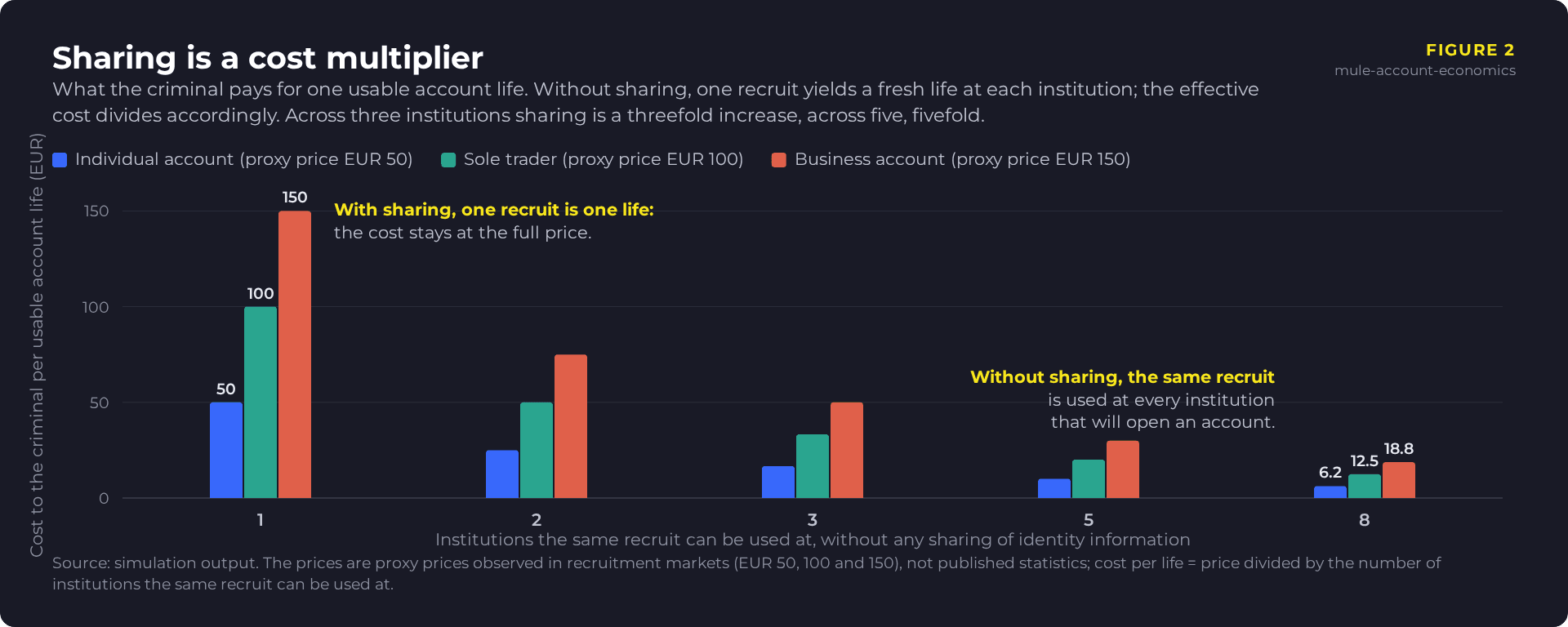 Figure 2. Sharing is a cost multiplier. What the criminal pays for one usable account life at proxy prices observed in recruitment markets (EUR 50 for an individual account, EUR 100 for a sole trader, EUR 150 for a business account). Without sharing, one recruit yields a fresh life at each institution and the effective cost divides accordingly. With sharing, one recruit is one life.
This is not a hypothetical mechanism. The UK regulator found that of 194,084 money mules offboarded by twenty-five firms between January 2022 and September 2023, only 37% were reported to the national fraud database, and one firm reported 6%. Nearly two-thirds of closures left no trace for the next institution. Whatever those closures achieved individually, they did not remove the recruit from the system.
It also produces a signal that nobody currently reads. A person recruited as a mule does not open one account; they open several, at different institutions, within a short period of time, because the operation wants them all at once. No ordinary customer opens accounts at ten institutions in a fortnight. One verified identity doing so is a strong indicator on its own, and it is derivable from identity data alone, without sharing anything about devices or behaviour. Today no institution can see it, because each sees only its own opening.
Why one institution getting tougher only partly helps
The institution that receives stolen funds is not the institution that lost them. In the ordinary case it is an entirely law-abiding business whose customer turned out to be a mule. It carries the cost of investigating, of responding to notifications and to enquiries from law enforcement and banking partners, of freezing, of reporting and, not least, of the false alarms its controls generate against ordinary customers if it wants to avoid all of the costs just listed. It carries almost none of the financial loss, except where regulatory reimbursement rules allocate part of that loss to the receiving PSP..
Price both sides of that decision in the same units and an awkward result appears. It is easiest to see as two lines.
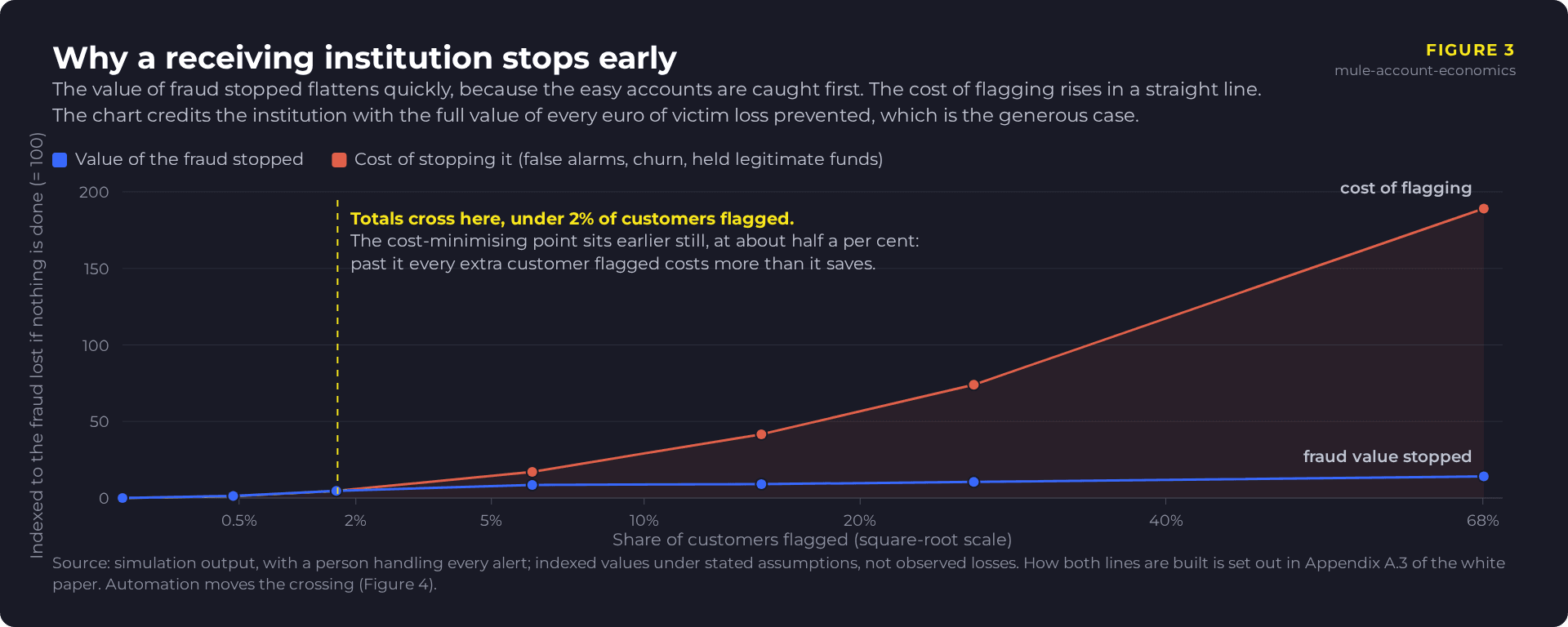 Figure 3. Why a receiving institution stops early. Both lines are indexed to the fraud that would be lost if nothing were done, with a person handling every alert. The value of fraud stopped rises steeply at first and then flattens, because the accounts that are easy to catch get caught quickly and the rest are structurally hard. The cost of flagging rises in a straight line. The two totals cross under two per cent of customers flagged; the cost-minimising point comes earlier, at about half a per cent.
The chart is drawn on an assumption that is generous to the institution, and it is worth being explicit about it. It credits the institution with the full value of every euro of victim loss prevented, as though the institution itself were out of pocket for all of it. It is not. The victim loses the money and the sending institution carries any reimbursement. What the receiving institution actually books is the cost of the false alarms, and almost none of the benefit. So the chart is the generous case, and the crossing point on it is already early. Redraw it with the benefit allocated the way the money actually moves and the institution’s own crossing point arrives sooner still.
The logic in three steps. The party in the best position to stop the money, the receiving institution, does not lose the money. That party does bear the whole cost of stopping it: staff time, customers inconvenienced, customers lost. So the level of effort that is rational for the institution sits well below the level that is best for society. The gap is a structural feature of who bears what, not a failure of management. It is also the standard case for regulating an activity rather than leaving it to the market, and it is why firm-level cost-benefit cannot be the basis for setting the bar. It is, incidentally, the economic argument for reimbursement regimes that reach the receiving side: the UK’s mandatory APP reimbursement rules, in force since October 2024, split the cost of reimbursing a victim equally between the sending and the receiving firm, which is the first regime to put part of the loss where the stopping power is.
The PSR will introduce some important changes, and the change is worth understanding. Article 78 gives an institution that has reimbursed a payer a right of recourse against another institution whose failure of its own duties contributed to the loss. The duty that matters for the receiving side is Article 83. Its transaction-monitoring obligation is not only the payer’s: under the final compromise text, “the payment service provider of the payee shall also carry out transaction monitoring before the funds are made available to the payee”, and “where a payment service provider does not carry out such monitoring with respect to a transaction and the payer incurs financial damage, that payment service provider shall bear liability.” Read together with Article 69, which gives the payee’s institution the power to refuse to make funds available or to return them, that is a duty to look at the money before releasing it, and liability for not looking. From 2028 a receiving institution that failed those duties can therefore carry part of the loss. That narrows the gap this article describes without closing it. It also means the outcome standards recommended below are exactly what a recourse claim would test: did the receiving institution monitor before it made the funds available, and did it act on what it saw?
What automation changes, and what it does not
A fair objection to all of this is that the cost of a false alarm assumes a person handles it. It need not. The receiving account can be blocked automatically, or the customer can be asked to re-verify themselves and clear the block without anyone at the institution touching the case. So I ran the simulation again at five levels of automation. The result was not the one I expected.
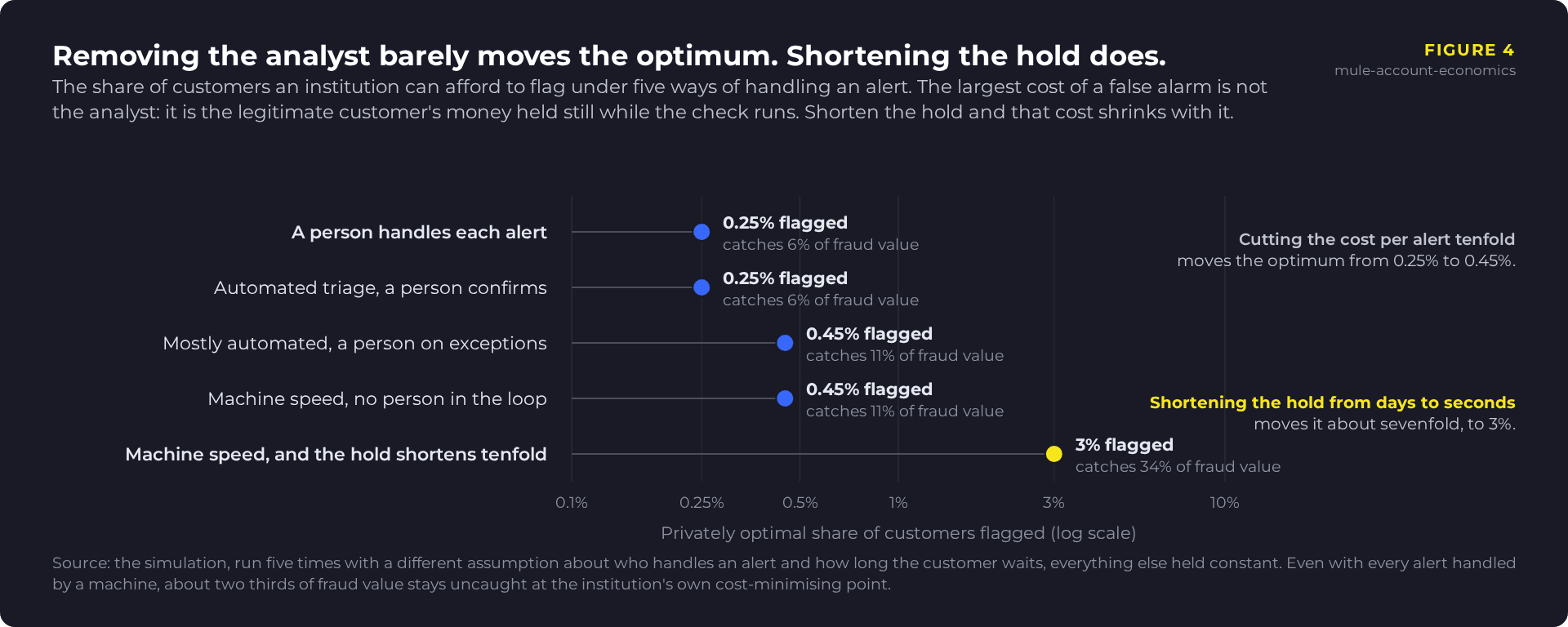 Figure 4. Removing the analyst barely moves the optimum; shortening the hold does, because the largest cost of a false alarm is not the analyst’s time but the legitimate customer’s money held still while the check runs. The share of customers an institution can afford to flag, under five ways of handling an alert.
Cutting the cost of handling an alert by a factor of ten moves the optimum from a quarter of a per cent of customers to under half a per cent, and cuts total cost by about one per cent. Removing the analyst is close to irrelevant. What moves the answer is the length of the hold.
The reason is in how the cost of a false alarm is built, and it is worth spelling out because it is counterintuitive. In the model a false alarm costs three things. It costs the time of whoever handles it. It costs the customers who leave because they were wrongly blocked. And it costs the money that a legitimate customer cannot use while the check runs: money that would otherwise have been transacting, earning the institution its normal margin and the customer whatever it was for. That last item is what “revenue foregone” means. It is priced in the model at the institution’s ordinary margin on the value held, multiplied by how long it is held. At the crossing point in Figure 3, roughly half of the cost of a false alarm is that held money, about two fifths is the time spent handling the alert, and under a tenth is customers lost. Shorten the hold from days to seconds and the largest component shrinks in proportion: the institution can then afford to flag roughly seven times as many customers, and it catches a third of fraud value instead of a twentieth.
That is also the answer to a reasonable question about the word “automation”. Automation is usually understood as acting faster, and here it appears to act only cheaper. The distinction the model draws is between two things that are often bought together but need not be. Automating who handles the alert removes the analyst but, if the case still waits for a review cycle, holds the customer’s money for exactly as long as before; that is the cheaper kind, and it barely moves the optimum. Automating how quickly the case resolves, for instance a re-verification the customer completes on their phone in a minute and an automatic release when it passes, shortens the hold; that is the faster kind, and it is the one that moves the answer. Automation helps when it is used to act quicker, not merely to act cheaper.
Two things follow. Automation is usually justified as a way to handle more alerts with fewer people; on these numbers that is the small prize, and the large prize is resolving the alert fast enough that the customer barely notices, which is a different engineering problem with a different budget. And the finding survives: even fully automated, the institution’s own best operating point leaves roughly two thirds of fraud value uncaught. Automation narrows the gap between what an institution will do and what society would want. It does not close it.
And the displacement question
Now add a second institution. I modelled a criminal operation choosing between institutions by which offers the best return per day. When the tightened institution stops being worth using, the operation does not stop. It reallocates, which is what displacement means.
How much of a unilateral tightening is prevention rather than relocation depends on how much spare capacity exists at weaker institutions, and the honest answer is a range. The crime-prevention literature finds displacement in about a quarter of measured cases, and usually smaller than the effect it displaces. The payments-specific evidence points the other way, and for once it is measured rather than inferred: in the only regime that ever published receiving-side fraud rates by named institution, the UK regulator’s APP scams performance reports, the three worst-performing firms in the latest edition handled 3% of the payments and received 15% of the reported scam losses. On the evidence, unilateral tightening reduces the system-wide total by somewhere between nothing and about a third. Where the softest institution has room to absorb, tightening moves the problem. Where it does not, tightening genuinely reduces it.
That is why a common floor matters more than individual firm performance. By a common floor I mean a minimum standard of receiving-side control that every institution in the scheme must meet, whatever its size or business model, so that there is no softer institution left for the volume to move to. Raise one institution above the floor and its fraud goes elsewhere; raise the floor and it has nowhere to go.
About the numbers. Every figure in this series is the output of a simulation that runs a criminal operation, described by attack patterns drawn from real-life cases and typologies, against a representative electronic money institution, described by its onboarding checks, monitoring, limits and speed of response. Detection is bought with false alarms rather than assumed; controls are allowed to fail together; and both fraud losses and control costs are expressed in the same unit, so an optimum exists and can be located. Every result is a comparison between two runs that differ in exactly one thing, expressed as a ratio or multiple under stated assumptions. How the model is built, and every assumed parameter, are set out in Appendices A and B of the white paper, which will be available at the end of the series.
Recommendations from this part
Set scheme-level minimum outcomes, not identical rules. An institution that hardens unilaterally reduces its own fraud to near zero while reducing system-wide fraud by between nothing and about a third, because volume relocates to institutions with spare capacity. Supervision that grades firms individually therefore partly rewards relocation. A minimum outcome means a measurable result an institution must achieve rather than a method it must use: a maximum permitted time from first suspicion to containment, say, or a minimum share of reported fraudulent receipts that must be frozen or returned. A rule prescribes what you do; an outcome prescribes what must be true afterwards, and only the second is robust to an adversary who reads the rulebook.
Make the supervisory bar the share of reported fraud actually stopped. Detecting that an account is compromised achieves nothing without the ability to stop money leaving by the route it is actually leaving, and a substantial share exits by cash withdrawal, card spending and cryptocurrency. Detection without a corresponding action on the exit route is intelligence rather than containment.
The measurable form: for every case of reported fraudulent receipt, the amount and share the institution was able to freeze, block, report or send back. It is a single figure, comparable across institutions, and it cannot be met without stopping any money, which is more than can be said for detection rates or alert volumes.
One corollary follows from this article: a supervisor that wants a higher share of fraud stopped should focus not on generating a larger alert queue, but on reducing the time between suspicion and effective intervention. The shorter that interval, the greater the opportunity to stop the funds before they leave the receiving institution., because the share that escapes containment is what ultimately matters to the fraudster.
Publish inbound fraud performance by receiving institution. Every other recommendation in this series depends on being able to see where fraudulent volume goes, and at present nobody can. One regulator did it, across three editions between 2023 and early 2026, exposed a dispersion of two to three orders of magnitude between firms handling the same flows, and has since stopped. The European reporting, in the joint EBA and ECB report, aggregates to country level and is compiled from the paying side. Without receiving-side rates by institution on a stable definition, supervision cannot distinguish an institution that prevented fraud from one that never received any.
What this means in practice
For a receiving institution the findings are more useful than they are comfortable.
Measure your own operating point honestly. Argued as your friction against the victim’s loss, the case for inbound controls says flag almost nobody, and the arithmetic is right. The case for going further is victim harm, regulatory expectation and, from 2028, recourse exposure. Argue it as that, not as a return on investment it cannot be.
Shorten the hold before you enlarge the queue. The single largest cost in the model is legitimate money sitting still while a check runs, not the analyst who runs it. An automated block with step-up re-verification that a genuine customer clears in seconds changes the economics; a bigger alert queue does not.
Share accounts you close, and read what others share (as long as regulations allow). An offboarded mule who is not reported to a shared database is a fresh account life at the next institution, and the count of institutions at which one verified identity has recently opened accounts is a signal available today from identity data alone.
Build the evidence now. Under the PSR, liability increasingly turns on whether each statutory control was in place. The record of what your monitoring saw before funds were made available, when the hold was applied and what was returned is both your containment log and your defence.
This article reflects the author’s own analysis and views. It is provided for information only and does not constitute legal advice.
About the author
Adam Anklewicz is a financial-crime risk practitioner with 20+ years in banking, fintech and payments. A founder of Assayon.com, a financial-crime product risk scoring solution that allows institutions to launch products and services in a responsible and compliant way. He writes in a personal capacity; the views are his own and are not attributable to any employer.
Connect with the author: LinkedIn