
Every account that receives stolen money had to come from somewhere. Usually it comes from a person recruited to hand over the use of their account for a small fee; sometimes from a fabricated identity that passed the opening checks. The obvious response is to make that supply more expensive: prosecute more of the people who sell their accounts, and publicise what happens to them.
This article is about why that does not work. The short version is this: the people willing to lend their account are many, the criminal needs very few of them, and no realistic pressure on the price can close that gap. The rest of the article shows it step by step.
This is the 2nd of 4 articles on the economics of fighting fraud on instant payment rails. Part 1 of this series looked at the problem from inside an institution. It treated the account that receives stolen money as a piece of equipment with a price, a yield and a short working life, and showed why the institution holding it rationally stops tightening its controls long before most of the fraud is caught. This part steps outside. It asks what society as a whole can do about the supply of mule accounts, and what each option costs, rather than how an obliged institution should run its own controls. The institution returns at the end, because the answer changes how it should read its own numbers.
The argument runs in seven steps, from how few people a criminal operation actually needs to what that means for the fraud report on your own desk.
1. A large laundering operation needs surprisingly few people
Picture a laundering operation of a considerable size, one that moves in the order of EUR 10 million of stolen money a year. Each account it uses lasts for only a payment or two before it is stopped, for the reasons set out in article 1, and the payments have to stay small enough not to attract attention. So the operation gets through accounts quickly. At that size it needs a few hundred accounts a week. The most common pattern, at institutions with reasonably good prevention programmes, is an account that receives two payments over a couple of days and is then finished.
A few hundred people a week sounds like a lot, until it is put next to the population they are recruited from, which is, in principle, anyone with a bank account. That is the first half of the problem: the demand is small. The second half is what those accounts cost.
2. To make the business stop, an account would have to cost thirty-four times more, and the market would still supply it
An individual account changes hands today for about EUR 50. That is a proxy price observed in recruitment markets. For the typical two-payment pattern to stop being profitable, the simulation says the account would have to cost about thirty-four times that, circa EUR 1,700. Call that the break-even price. And here is the result the rest of the article turns on. At EUR 1,700 the simulation still finds more than forty people willing to sell an account for every account the operation needs. How it works?
Every person who could be reached has a price below which they will not hand over their account. A few will do it for very little. Most want considerably more. Some will not do it at any price. Line the whole reachable population up by asking price and a curve appears. At a low price only a few people are willing. As the price rises, more and more join, quickly at first, because for most willing people (ethics aside) the asking price sits within a few multiples of today’s. At a high enough price nearly everyone willing who can be reached is in, and the curve flattens, because there is nobody left to recruit. The laundering operation, for its part, needs a fixed number of accounts a week. It pays the lowest price at which that many people are willing. Let’s call that the clearing price.
Enforcement enters through each person’s asking price. The greater the chance of being caught they believe they face, the more they want for taking the risk. So at any given price fewer people are willing, and the whole curve shifts to the right. That is the only way prosecution or publicity can act on this market: by moving the curve.
Figure 1 draws all of this. The horizontal axis is the price paid for a mule account, as a multiple of today’s price. The vertical axis is the number of people willing at that price, as a multiple of the number the operation needs; the dotted line at one is where supply exactly meets demand. The three curves are today’s market and the market under two enforcement assumptions, explained in the next step. The three marked points are the clearing prices, and the vertical line at thirty-four times is the break-even price. Read the curves at that line and the problem is visible at a glance. Even at thirty-four times today’s price there are about forty-one willing people for every account the operation needs. The operation never has to pay anything like it, because it only needs a few hundred of them.
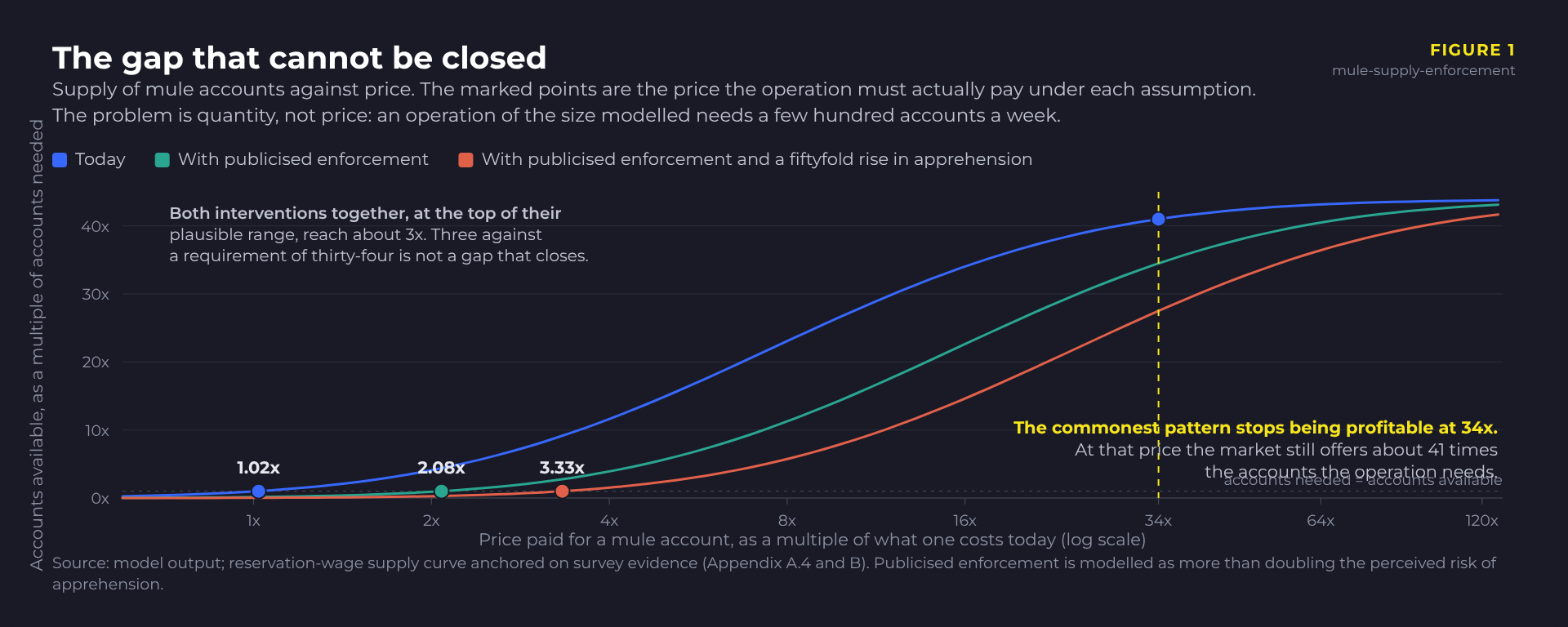 Figure 1. The gap that cannot be closed.[1] Horizontal axis: the price paid for a mule account, as a multiple of what one costs today. Vertical axis: accounts available each week, as a multiple of what the operation needs.
So the price would have to rise thirty-four times. The next question is how far prosecution and publicity can actually push it.
3. Prosecution and publicity move the price by three times, not thirty-four
Two things usually get mixed up here, and they have to be kept apart: the actual chance that a mule is caught, and the chance as perceived by someone deciding whether to become one. They differ, and different costs apply to shifting each of them. Publicity moves perception cheaply, without changing the underlying rate. Enforcement volume moves the underlying rate, expensively and slowly. Neither is well measured. The actual probability of being caught has not been published in any jurisdiction. The perceived side has been measured once, in a survey of more than 3,000 Dutch 16-to-25-year-olds: the respondents’ awareness of the risks of money muling was low, and they underestimated the consequences of being caught.[2]
I took the generous case deliberately. Publicised enforcement is assumed to more than double the chance of being caught as recruits perceive it. Real enforcement on top of that is assumed to raise the actual chance fiftyfold, the top of the range I considered plausible. Each assumption shifts the supply curve to the right, and the operation moves up it to a new clearing price: about twice today’s price with publicity alone, roughly EUR 100, and about 3.3 times with both, roughly EUR 165. That is still a tenth of the break-even price of about EUR 1,700. The most that supply-side pressure can do, on generous assumptions, leaves the account far below the price at which the business would stop being profitable.
Why can no amount of pressure on the recruits close that gap? The answer is the one that research on deterrence has given for decades: what deters people from an offence is the certainty of being caught, far more than the severity of what follows. A simple calculation shows why, and why it matters even more for mules than for most offences.
Take one potential recruit. Suppose, purely for illustration, that they put the chance of being caught at one in a thousand (nobody knows the true figure; it has never been published) and the cost of being caught, in fines, legal costs and lost earnings, at EUR 5,000. The risk they take on is then worth EUR 5 to them: one in a thousand times EUR 5,000. Double the penalty and it is worth EUR 10. Treble it and it is EUR 15. Against a EUR 50 payment, none of these changes the decision. To change it by severity alone, the penalty would have to exceed EUR 50,000, out of all proportion to the offence for a young person recruited through a job advertisement. Now move the other lever. Raise the chance of being caught fiftyfold, to one in twenty, and the risk is worth EUR 250, five times the payment. This recruit declines. That is why certainty rather than severity is the lever that works on an individual.
But the operation does not need to persuade this individual. It needs a few hundred people a week out of a reachable population many times larger. Among them are people who put the chance of being caught lower, who need the money more, or who never thought about it at all. When one recruit declines, the operation moves on to the next. That is the whole mechanism behind three times against thirty-four, and it rests on one assumption: that the pool really is that large. The next step checks that assumption against a real country.
4. The pool is real: one country’s young people against one operation
Recruitment advertising works. A controlled study ran realistic recruitment-style advertisements to young social-media users and measured engagement of up to 3%, strongest for material promoting a luxury lifestyle. The Dutch survey mentioned above gives the reach of that recruitment. More than half of 16-to-25-year-olds had already been exposed to such advertising. Roughly one in twelve had been directly approached by a recruiter. Just under one in a hundred said they had at some point acted as a mule.[3]
Those shares are worth putting against a real population, as a rule of thumb rather than a measurement. Take a country of about 37.5 million people, Poland, where about 3.7 million people are aged 16 to 25.[4] If the Dutch shares held there, at least 1.85 million of them would have seen mule recruitment advertising (the survey says more than half; I take half, so that the error runs towards understatement). About 310,000 would have been approached directly. About 30,000 would say they had already acted as a mule at some point. The operation from step one needs a few hundred accounts a week, roughly 15,000 a year. The people in one country of that size who say they have already done it outnumber that need about two to one. The people who have been approached outnumber it about twenty to one.
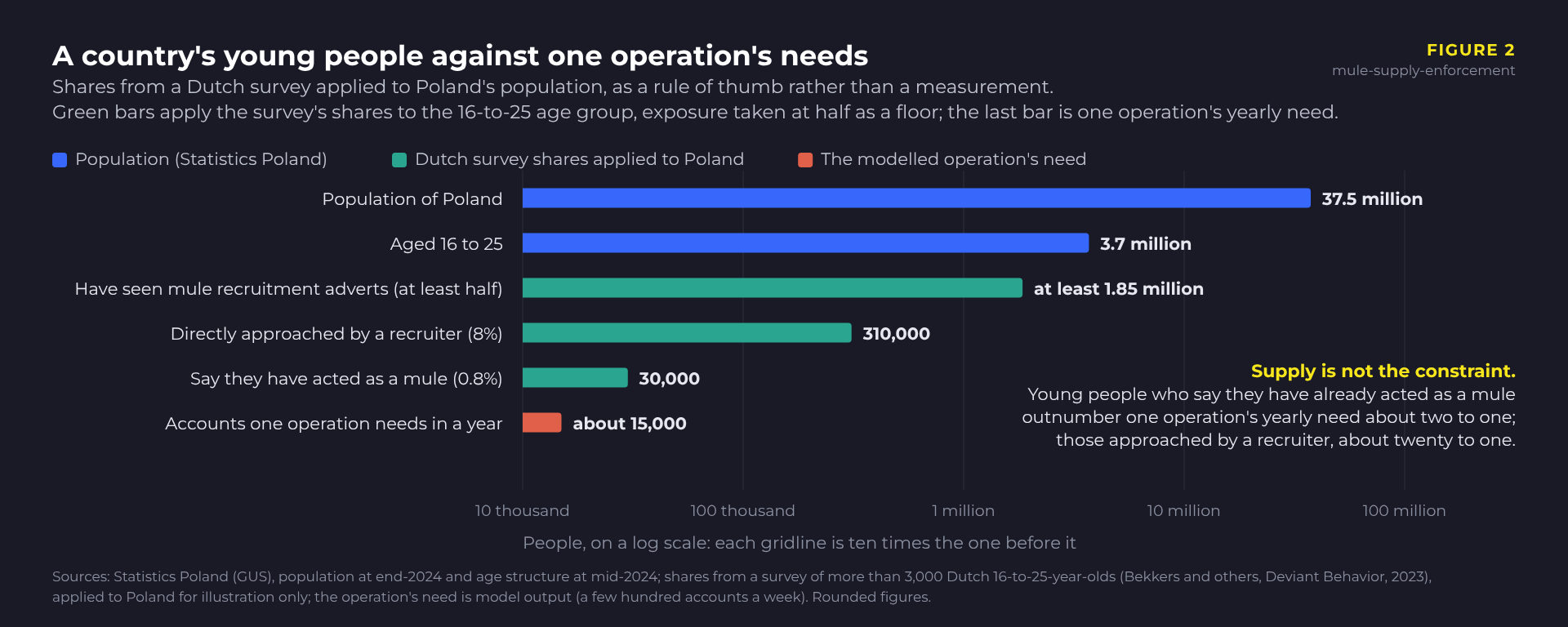 Figure 2. A country’s young people against one operation’s needs. Shares from the Dutch survey applied to Poland’s population, as a rule of thumb rather than a measurement; exposure to recruitment advertising is taken at half, the floor of the survey’s “more than half”.
The caveats are real. The shares come from one Dutch survey and no equivalent Polish survey exists; “have ever acted as a mule” accumulates over several years rather than one; and self-reporting understates offending rather than overstating it. None of them changes the picture. The pool is large, recruiters are working it, and it dwarfs what any single operation needs.
If the pool cannot be priced away, the next hope is to shrink it: persuade people not to join. That is what awareness campaigns are for, and this is where the evidence runs thin.
5. The usual answer, awareness campaigns, has never been tested
No money-mule awareness campaign anywhere has ever been evaluated for its effect on behaviour. Not the pan-European campaigns that run alongside coordinated enforcement actions, not the long-running UK campaign aimed at young people, not the national campaigns in the Netherlands or Belgium. What gets published is reach: languages, schools, letters served, arrests. Whether recruitment fell is not published anywhere.
Two things are known, and neither is comfortable.
The first concerns the message itself: the traditional warning is probably not the best one available. Only one experiment has compared different ways of framing a warning to potential cyber offenders. A frame, here, means the argument the message leads with. The researchers wrote four versions of the same online warning:
- a deterrent version, meaning “you will be caught”, which is the design most campaigns use;
- a social version, appealing to what other people do and what they would think;
- an informative version, explaining what the conduct is and that it is a crime; and
- a reorienting version, offering something lawful to do instead.
The four versions were shown as online adverts to internet users. The researchers measured how many clicked on the warning and how much of the page behind it they read. The social version generated significantly more engagement than the other three. Two qualifications matter. The experiment measured whether people engaged with the message, not whether they went on to offend. And the offence it addressed was not money muling: the warnings were shown to people searching online for services that knock websites offline, so-called DDoS attacks. So the finding transfers to mule recruitment with caution. It is still the only direct test there is, and it went against the intuitive design.[5]
The second is that awareness is probably not what limits recruitment in the first place. Qualitative work with people who had acted as mules found that they judged risk through personal safety and trusted relationships rather than legality, and several did not recognise their conduct as an offence at all.[6] A campaign aimed at legality addresses a consideration they were not making.
The honest position is not that awareness campaigns fail. It is that after roughly a decade and at least six major national and pan-European programmes, nobody has measured whether they work, and the one adjacent experiment suggests the standard message design is not the best available.
That leaves the question this article has been building towards. Of everything society can do, what actually changes the outcome? The model priced four options on the same yardstick.
6. Four options, one yardstick, one that works
The four are publicised enforcement, prosecuting recruited mules, disrupting recruitment, and rapid interdiction. The last is a technical name for a simple thing: the account is detected and blocked within hours of the first suspicious payment, and the same person is prevented from opening a replacement elsewhere. The yardstick is the total cost to society. It includes something usually left out: the harm done to people who were themselves recruited to become a mule, frequently through deception, when they are prosecuted. In the model that harm is counted as a cost, in the same unit as the victims’ losses and the money spent on controls and enforcement.
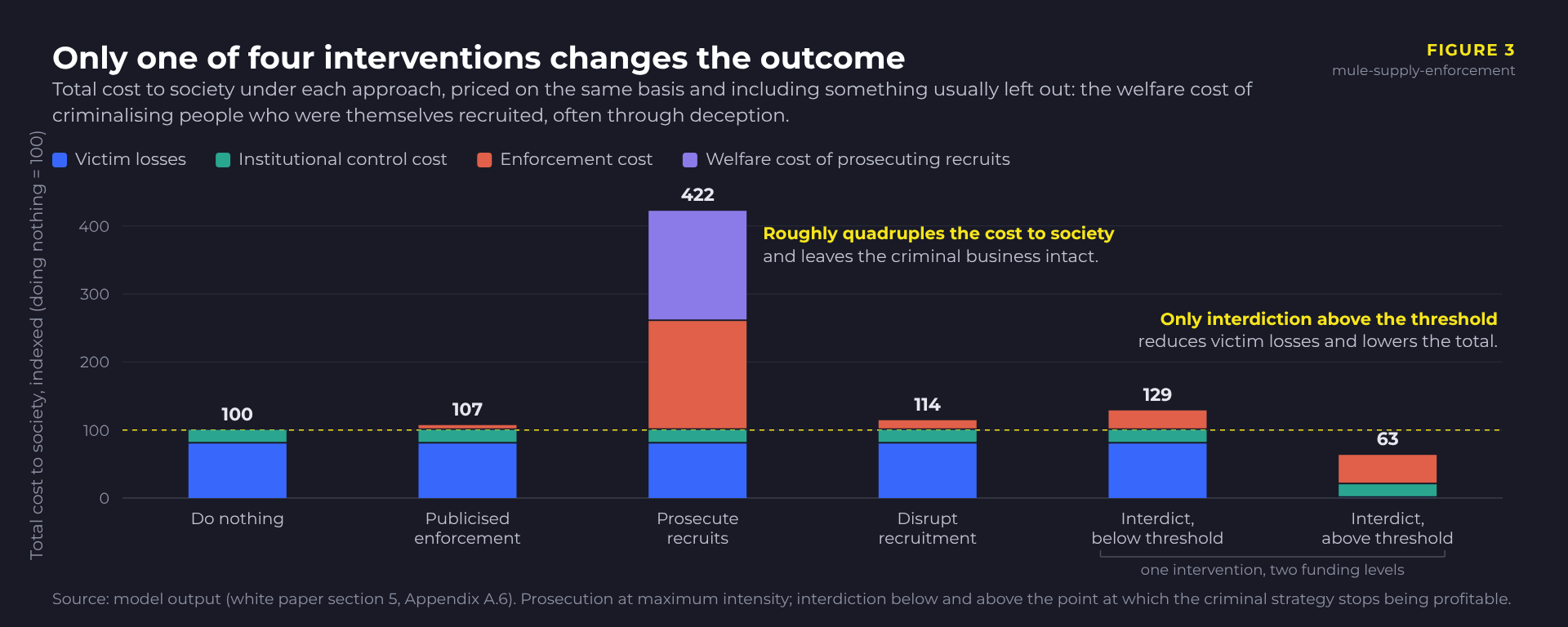 Figure 3. Only one of four interventions changes the outcome. Total cost to society under each approach, indexed so that doing nothing equals 100, and including the harm done to recruited people when they are prosecuted. Publicised enforcement is cheap and does not change the outcome. Prosecuting recruits is expensive and does not change the outcome. Only interdiction above the threshold at which the criminal strategy stops being profitable both reduces victim losses and lowers the total.
The chart reads from left to right. Doing nothing costs 100: about 80 is money lost by victims and about 20 is what institutions already spend on controls. Publicised enforcement adds a little cost and changes nothing. Prosecuting recruits at maximum intensity takes the total to a little over 400. The victims still lose their 80, enforcement costs about 160, and the harm to the people prosecuted adds about as much again, while the criminal business carries on. Disrupting recruitment is cheap and does no harm to anyone, and on its own it does not change the outcome either.
The last two bars are the same intervention, rapid interdiction, at two levels of funding, and the difference between them is the most important thing on the chart. What the funding buys is speed and reach: how quickly a mule account is found and blocked after the first suspicious payment, and how reliably the same person is stopped from opening a replacement elsewhere. Interdiction works by cutting what a mule account earns before it is stopped. Speed and reach decide how much of that it cuts.
An underfunded programme finds accounts, but late and patchily. It catches an account after most of the money has already been forwarded, or closes it at one institution while the same person opens the next (and this is a fair representation of current situation in most of EU countries). It removes only part of the yield, less than the break-even level at which the fraudster’s operation stops being profitable. So the fraudster accepts a thinner margin and carries on exactly as before. The victims lose as much as they did, the institutions pay as much as they did, and society now also pays for the interdiction effort. That is the bar at 129, higher than doing nothing.
A sufficiently funded programme is fast and wide enough to remove most of the yield: the bulk of the value before the second payment can be forwarded, and at every institution at once. Part 3 puts the level at about three quarters of an account’s value with a strong control stack and about ninety per cent with today’s controls. Past that level the account no longer pays for itself, so the operation stops. Victim losses all but disappear, because the fraud is no longer carried out at scale. What society still pays is the cost of running the interdiction capability, about 43, plus the institutions’ ordinary controls, about 20. That is the bar at 63. The better-funded version costs about half as much again as the underfunded one, and yet the total is less than half, because it removes the losses instead of adding to them. Where exactly the level sits, and why there is no partial benefit below it, is the subject of part 3.
There is a reason speed matters so much, and it comes from how people learn. Offenders update their sense of risk from experience. Those who act and are not caught revise their perceived risk downward, and those who see others act unpunished do the same. A mule who receives and forwards funds unchallenged is being taught, actively, that the risk is low. That is a strong argument for fast, visible intervention on the first suspicious receipt, and an argument against broad messaging, which does not address the experience doing the teaching.
None of this argues that mule recruitment should carry no consequence, nor that prosecuting the organisers of laundering networks is a poor use of resources. The case for that is strong, and this analysis takes no position on it. Once stolen money has landed it is the proceeds of crime, and pursuing the people behind it is a matter for the anti-money-laundering regime and for prosecutors. The argument here is narrower:
Prosecuting recruited account holders is not a viable way to reduce the supply of mule accounts.
The intervention that works best is also the most humane one. Close the account, block the identity at other institutions as far as the rules allow, warn the individual. Fast, certain and low in severity. Efficiency and decency point the same way here, which is not always true in criminal policy.
There is one more thing the model shows, and it is the one most useful to anyone who runs controls inside an institution.
7. Price pressure and institutional controls attack from opposite ends
So far this article has used one pattern, the typical mule account that receives two payments over a couple of days. The model ran seven patterns, each taken from practice. Each describes a different way of moving stolen money through an account: how much arrives, in how many payments, how quickly, into what kind of account, and how it leaves. Figure 4 lists them, with the break-even price of each as a multiple of what its account type costs today.
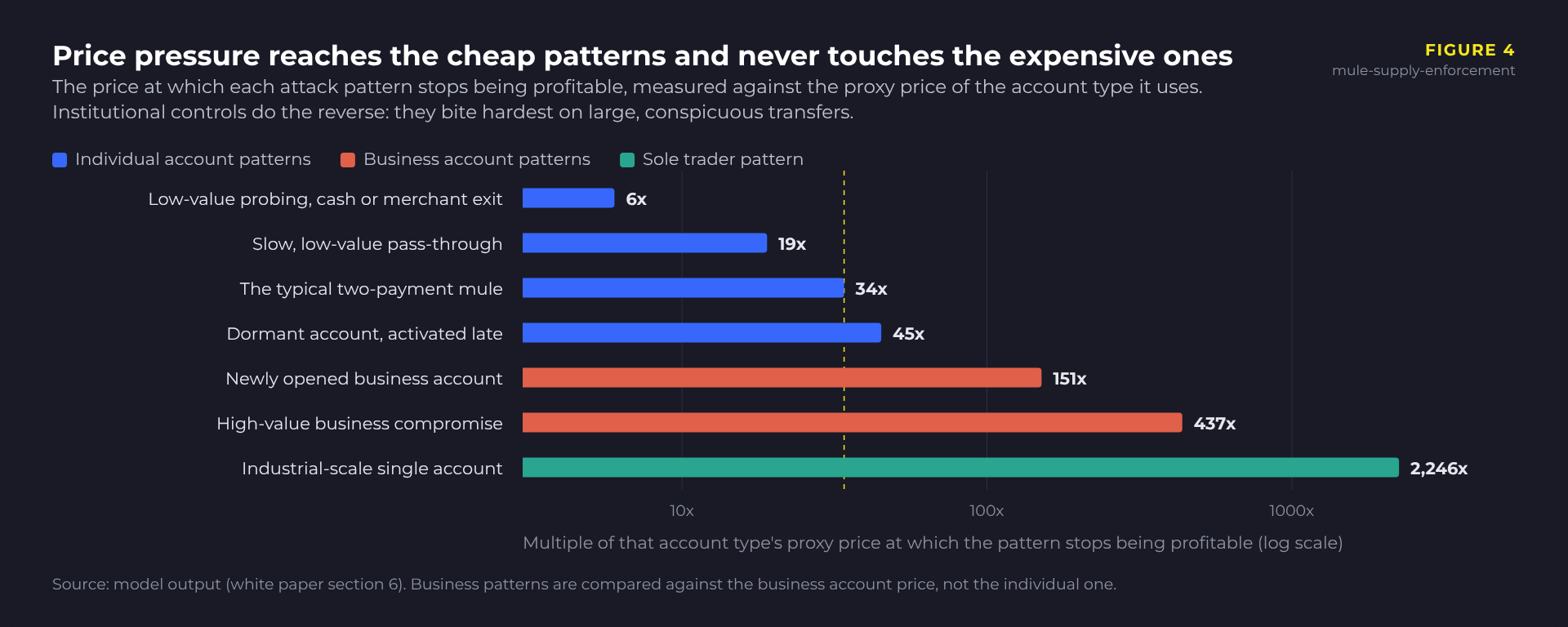 Figure 4. Price pressure reaches the cheap patterns and never touches the expensive ones. The price at which each attack pattern stops being profitable, measured against the proxy price of the account type it uses. Business patterns are compared against the business account price rather than the individual one.
At the proxy prices, the cheapest pattern, low-value probing with a cash or merchant exit, stops being profitable once an individual account costs around EUR 300. The typical two-payment mule needs about EUR 1,700. A newly opened business account used for fraud goes on paying for itself until a business account costs more than EUR 22,000, and a high-value business compromise until it costs more than EUR 65,000. No policy aimed at recruits moves the price of a business account by anything like that.
So raising the cost of an account kills the cheap, fast, low-value patterns first and never reaches the high-value ones. Institutional controls do the reverse. Monitoring, value limits and rapid freezing bite hardest on large, conspicuous transfers and least on a small payment that looks like any other. These two opposing forces attack the problem from both angles, and that is exactly how it should be done. Run only one, and the fraud does not stop. It migrates to whatever the other would have caught.
This answers a question that practitioners often raise, usually with some puzzlement. Picture the monthly fraud report at an institution that has spent a year tightening its controls. The number of fraud cases is up. The average amount per case is down, and keeps falling. Total losses are flat or slightly lower. Meanwhile the large cases that used to dominate the report have almost vanished.
The instinct (also among regulators) is to ask what new attack explains the rising count, and to worry that the controls are not working. On this model nothing new needs to have happened, and the controls are working. Strong institutional controls catch the big, conspicuous transfers and leave the small, fast ones standing. So the big cases disappear from the report and the small ones become the whole of it. Nothing on the institution’s side touches the supply of recruits, so the small cases keep coming. An institution seeing rising incident counts and falling average values is watching its own controls work exactly as designed, on the half of the problem they can reach.
Also read:
Money mule economics: why the receiving institution underinvests in stopping fraud
Recommendations from this part[7]
Fund speed of response, not severity of punishment. Rapid interdiction, as defined in step six, is the only intervention in the model that makes the criminal strategy stop being profitable. Prosecuting recruited mules failed to change the outcome at any intensity tested, because the certainty of being caught, not the severity of the penalty, is what deters. No realistic increase in penalties fixes a probability that starts near zero. Every unchallenged receipt teaches the mule that the risk is low. Enforcement budgets measured in cases brought are optimising the wrong variable. The variable that matters is the number of hours between the first suspicion and the account being blocked, with the same identity blocked at other institutions, as far as the rules allow.
Fund recruitment prevention properly, and evaluate it, because nobody ever has. Prosecuting recruited account holders loses on every measure. It does not make the criminal business unprofitable, it consumes enforcement resources at several times the cost of the alternatives, and it imposes lasting harm on a population frequently recruited through deception. Recruitment prevention costs a fraction as much and harms nobody. Campaigns should continue, because they are cheap and the alternative is worse. And the next campaign should be run as an experiment with a control condition, since the method exists and has been demonstrated in published research. The cost of adding evaluation is trivial next to the cost of a decade of unmeasured spending.
What this means in practice
For a receiving institution, three things follow.
- Do not expect the supply of mules to dry up, and do not build a control strategy that assumes it will. An operation needs a few hundred accounts a week, and any plausible population supplies that many at almost any price. What actually limits the criminal is what each account yields before it is stopped, and that is inside your control.
- Read your own fraud mix as the result of your controls, not as a new threat. Falling values and rising counts after a control programme are what the programme should produce. They are not evidence that it failed, and they are not evidence that the problem has gone. They are evidence that the small, fast patterns are now the ones left standing, and those need the speed of freeze that article 3 in this series describes rather than more friction at onboarding.
- If you run or fund awareness activity, measure it. A campaign with a control condition costs almost nothing more than a campaign without one. And the one adjacent experiment suggests that the deterrent message most campaigns lead with is not the best of the four designs tested.
Notes and sources
[1] The curves and the marked points are outputs of the simulation and the market model described in the note to the section “Recommendations from this part” below: multiples under stated assumptions, not observed prices or counts. The euro figures in the text apply those multiples to proxy prices observed in recruitment markets (EUR 50 for an individual account, EUR 100 for a sole trader, EUR 150 for a business account), which are not published statistics.
[2] Bekkers, Van Houten, Spithoven and Leukfeldt, Money mules and cybercrime involvement mechanisms: exploring the experiences and perceptions of young people in the Netherlands, Deviant Behavior, 2023 (doi 10.1080/01639625.2023.2196365). An online survey of more than 3,000 respondents aged 16 to 25.
[3] The advertising experiment: Bekkers, Moneva and Leukfeldt, Understanding cybercrime involvement: a quasi-experiment on engagement with money mule recruitment ads on Instagram, Journal of Experimental Criminology (doi 10.1007/s11292-022-09537-7). The exposure, approach and participation shares: the survey cited in the previous note.
[4] Statistics Poland (GUS): population 37.49 million at 31 December 2024; about 3.7 million aged 15 to 24 at 30 June 2024, used here as the nearest published bracket to 16 to 25. The derived figures are the survey shares applied to that bracket, rounded.
[5] Moneva, Leukfeldt and Klijnsoon, Alerting consciences to reduce cybercrime: a quasi-experimental design using warning banners, Journal of Experimental Criminology (doi 10.1007/s11292-022-09504-2).
[6] United Kingdom Home Office, Lived experiences of money muling, 2026.
[7] Every figure in this series is the output of a simulation that runs a criminal operation, described by attack patterns drawn from real-life cases and typologies, against a representative electronic money institution, described by its onboarding checks, monitoring, limits and speed of response. This part adds a market around the simulation, describing where mule accounts come from: each person has a price below which they will not hand over an account, those prices differ from person to person, and only so many people can be reached, which is what turns “buy more accounts” into a cost rather than a free option. The size of the reachable population is anchored on survey evidence; the price of an account on proxy prices observed in recruitment markets; the spread of those prices and the actual chance of being caught are assumed and tested across a wide band, because neither has ever been published. Every result is a comparison between two runs that differ in exactly one thing, expressed as a ratio or multiple under stated assumptions, not as an observed loss or price. How the model is built, and every assumed parameter, are set out in Appendices A and B of the white paper, which will be available at the end of the series.
This article reflects the author’s own analysis and views. It is provided for information only and does not constitute legal advice.