
Across the globe, numerous terrorist groups operate with varying ideologies, goals, and regional focuses, such as Al-Qaeda, ISIS, Boko Haram, Hezbollah, and the Taliban. These organizations need funds to sustain and expand their operations, therefore combating terrorism remains a critical challenge for global security.
In this article, we will look deeper into this typology to understand the problems and complexities that financial institutions face related to this topic.
What is Terrorism Financing?
The key purpose of terrorism is to instil fear, disrupt societal order, and advance specific agendas (for example, political, ideological, religious etc). Terrorists aim to create a climate of uncertainty and insecurity, often targeting civilians, governments, or symbolic entities to maximize psychological impact. By carrying out violent acts, terrorist groups seek to coerce governments, influence public opinion, or draw attention to their causes. Ultimately, terrorism is designed to exert power and pressure disproportionate to the group’s actual size or resources, leveraging fear as a tool to achieve their strategic objectives. Hence, terrorism financing refers to the act of providing funds or financial support to individuals, groups, or activities involved in the act (or a planned act) of terrorism. The sources of financing can be both legitimate (e.g., donations from sympathizers, charity fronts, crowdfunding platforms etc) and illegitimate (e.g., drug trafficking, smuggling, extortion, and money laundering). For instance, ISIS has historically exploited oil revenues and looted antiquities from the museums in the occupied territories.
While the terrorists can use the funds directly for purchasing weapons, explosives, and ammunition, the funds can also be used in indirect ways, for example:
- Planning and executing attacks (e.g., travel, logistics)
- Funding safe houses and operational infrastructure
- Training (e.g., how to use weapons or create bombs)
- Running front organizations, such as charities or NGOs, to generate more funds
- Providing financial support to families of terrorists (e.g., after successful suicide attack)
- Facilitating forged documentation for operatives
- Recruitment and propaganda campaigns via social media and communication channels for radicalization
Different Types of Terrorism Across the EU
For EU based companies I would highly recommend reading the 2024 Europol Terrorism Situation and Trend Report (TE-SAT) which provides a comprehensive analysis of various types of terrorism affecting the European Union (EU). The 2024 report indicates that in 2023, 120 terrorist attacks were recorded in the EU and a total of 426 persons were arrested for terrorism-related offences. Of the 120 attacks, 98 were completed, 9 failed, and 13 were foiled. Most of the attacks took place in France (80).
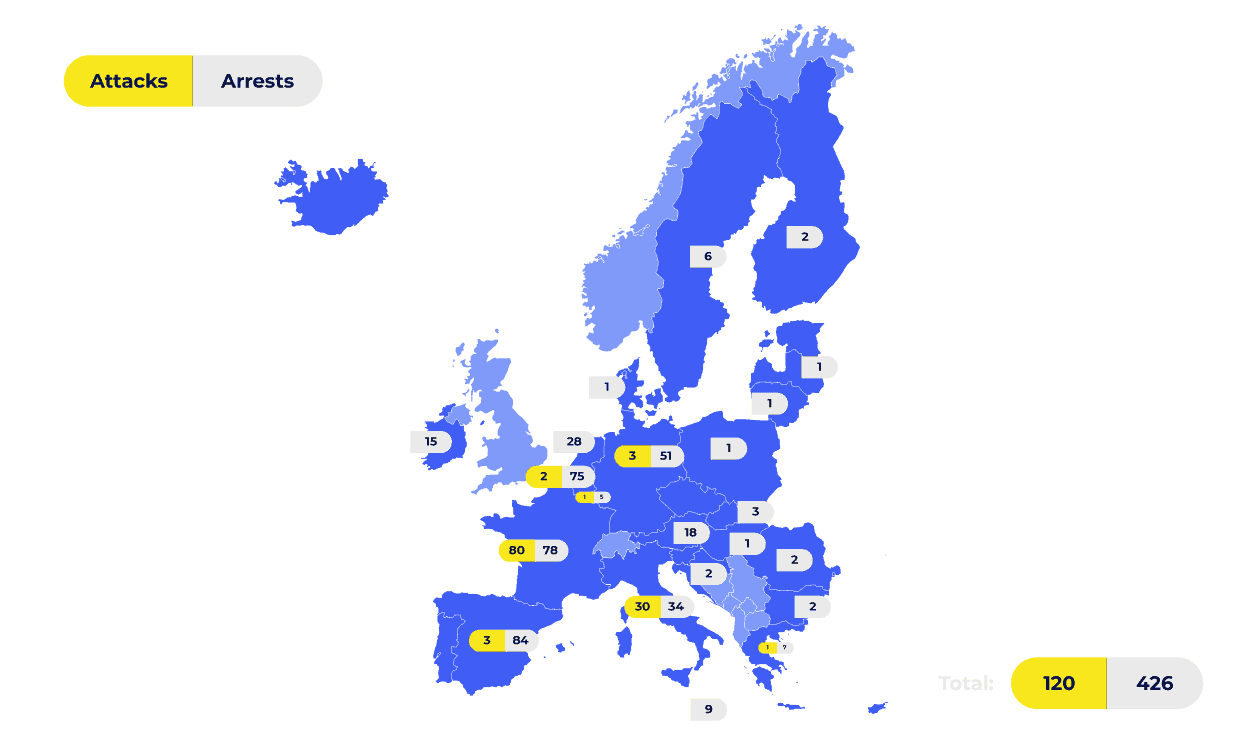
According to the report, the main types of terrorism in the report are as follows:
-
Religious Terrorism
Religious Terrorism is driven by ideological or spiritual motives. In 2024, the Jihadist terrorism remained the most significant threat to EU security. According to TE-SAT, jihadism is defined as a violent sub-current of Salafism, a revivalist Sunni Muslim movement that rejects democracy and elected parliaments, arguing that human legislation is at odds with God’s status as the sole lawgiver. Jihadists aim to create an Islamic state governed exclusively by Islamic law (shari’a), as they interpret it. Unlike other Salafist currents, jihadists legitimise the use of violence by referring to the classical Islamic doctrines on jihad which jihadists treat as religiously sanctioned warfare. All those who oppose jihadist interpretations of Islamic law are considered as ‘enemies of Islam’ and therefore considered legitimate targets. Some jihadists include Shi’a, Sufis and other Muslims in their spectrum of perceived enemies.
In 2023, there were 14 attempted jihadist attacks, with five completed, all carried out by lone actors. Notably, young people are increasingly involved in producing and disseminating online propaganda, with 334 arrests for jihadist-related offenses, many involving youth.
-
Right-Wing Terrorism
Right-wing actors (groups or individuals) seek to use violence to transform the entire political, social and economic system into an authoritarian model, rejecting democratic order and values and fundamental rights. Violent right-wing ideologies use narratives centred on exclusionary nationalism, racism, xenophobia and/or related intolerance. A core concept of right-wing violent extremism is supremacism or the idea that as a group of people sharing a common element (nation, race, culture, etc.), they are superior to all others and consider it to be their natural right to dominate the rest of the population. In addition, right-wing violent extremist ideologies feed on a variety of hateful sub-cultures, that often oppose diversity in society and equal rights of minorities, such as misogyny and hostility towards LGBTQ+ communities and anti-immigration attitudes.
While only two right-wing terrorist attacks were reported in 2023, both foiled, the threat remains significant. Right-wing extremists, particularly younger individuals, are active in online communities, producing propaganda, inciting violence, and experimenting with technologies like 3D-printed firearms. Narratives such as eco-fascism and anti-system rhetoric have gained prominence, combining environmental concerns with extremist ideology.
-
Left-Wing and Anarchist Terrorism
Left-wing terrorist groups seek to trigger a violent revolution against the political, social and economic system of a state, in order to establish socialism and ultimately establish a communist and classless society. Their ideology is often Marxist-Leninist. Anarchist terrorism is a term often used to describe acts of violence committed by groups or individuals who promote the absence of authority as a societal model. Anarchists pursue a revolutionary, anti-capitalist and anti-authoritarian agenda.
In 2023, left-wing and anarchist terrorism accounted for 32 attacks, primarily targeting property and critical infrastructure. These groups often align their activities with socio-political grievances, such as anti-capitalist and environmental movements. Support for imprisoned anarchists and broader anti-state sentiments continue to drive violent acts.
-
Ethno-Nationalist and Separatist Terrorism
Ethno-nationalist and separatist terrorist groups are motivated by nationalism, ethnicity and/or religion. Separatist groups seek to carve out a state for themselves from a larger country or annex territory from one country to that of another. Left-wing or right-wing ideological elements are not uncommon in ethno-nationalist and separatist terrorist groups.
Separatist groups were responsible for the majority of completed attacks in 2023, all in Corsica, France which were tied to the Fronte di Liberazione Naziunale Corsu (FLNC) and Ghjuventù clandestina Corsa (GcC) groups that focus on regional independence and often target government buildings, financial institutions, and businesses to further their causes.
Terrorism Across the World
The September 11, 2001 (9/11) attack in the United States was the most well-known terrorist attack in modern history, however there were also such instances like the 2008 Mumbai Attack in India where the Pakistan-based terrorist group Lashkar-e-Taiba targeted multiple luxury hotels, a train station, and a Jewish community centre which killed 166 people and injured over 300. Also, there was the London Bombings in United Kingdom (July 7, 2005) where four coordinated suicide bombings targeted the London public transport system during rush hour. The attacks, carried out by Islamist extremists, killed 52 people and injured over 700, marking one of the deadliest attacks in the United Kingdom.
When considering the global scope, the 2024 Global Terrorism Index (GTI) report highlighted several key patterns on the global scale. For example:
- Increase in Terrorism-Related Deaths: in 2023, deaths caused by terrorism rose by 22% to 8,352, marking the highest level since 2017. This increase occurred despite a 22% decrease in the number of terrorist incidents, indicating that attacks are becoming more lethal. However, even if the Hamas attack in Israel were to be excluded, the global terrorism deaths would still have seen a small increase.
- Shift in Terrorism Epicentre: the central Sahel region of sub-Saharan Africa has overtaken the Middle East as the epicentre of terrorism, accounting for over half of all terrorism-related deaths. Groups such as the Islamic State (IS) and Jamaat Nusrat Al-Islam wal Muslimeen (JNIM), an Al-Qaeda affiliate, are notably active in this region.
- Concentration of Terrorism Impact: terrorism’s impact has become increasingly concentrated, with ten countries accounting for 87% of all terrorism-related deaths. This concentration has intensified over the past decade, with the number of countries recording at least one death from terrorism falling from 57 in 2015 to 41 in 2023.
The Key Differences Between Money Laundering and Terrorism Financing
Money Laundering and Terrorism Financing are different crimes; therefore it is important to understand the differences between them if we want to combat these crimes effectively.
Note: The examples provided below are for demonstration purposes only, and a comprehensive assessment is necessary to evaluate the specific risks and exposures faced by each company individually.
| Aspect | Money Laundering | Terrorism Financing |
|---|---|---|
| Primary objective | To conceal the origin of illegally obtained funds and integrate them into the legal financial system. | To provide financial support for terrorist activities or organizations, regardless of the source. |
| Source of funds | Funds are derived from criminal activities like drug trafficking, fraud, or corruption. | Funds can come from both legal sources and illegal sources. |
| Motivation | Profit-driven, aimed at preserving wealth and avoiding legal consequences. | Ideology-driven, aimed at supporting a political, religious, or social agenda through violence. |
| Key mechanisms | Placement, layering and integration to obscure the origin of funds, exploitation of certain legal entities (e.g., limited liability companies). | Can involve layering, using informal networks like hawala, consumer networks, exploitation of certain legal entities (e.g., charities). |
| Jurisdictions-involved | Local (intra-country) transfers, Countries with lax beneficial ownership requirements, typology-specific countries (e.g., tax evasion). | Cross-border transactions, transfers to countries that present high risk for terrorism (e.g., Somalia, Burkina Faso, Syria etc.) or has active terrorist organizations. |
| Size of the transaction | Usually involve medium to high sums of money | Usually involve small sums of money |
Combating Terrorism Financing
Countries around the world tackle terrorism financing through a combination of legislative measures, financial regulations, and international cooperation. Key efforts include laws that require financial institutions to detect and report suspicious activities, as well as sanctions against individuals or organizations associated with terrorism. For example, in the United States, the USA PATRIOT Act, enacted after the September 11 attacks, plays a central role in combating terrorism financing and requires financial institutions to establish robust anti-money laundering (AML) programs, conduct thorough customer due diligence, and report suspicious transactions to authorities. In the European Union, the 5th Anti-Money Laundering Directive (5th AMLD), implemented in 2020, strengthened measures against terrorism financing which mandated greater transparency in financial transactions, particularly those involving virtual currencies.
However, there is no “silver bullet” for combating terrorism financing and to this day financial institutions face many complexities when tackling terrorism financing-related cases, like:
- Regulatory and Compliance Burden: Institutions must comply with stringent anti-terrorism financing laws, which require significant resources for monitoring, reporting, and maintaining due diligence.
- Disguised Transactions: Terrorist financing often involves small, inconspicuous amounts or layered transactions designed to avoid detection, making it harder to identify suspicious activity as they can appear as normal transactions related to family support activities.
- Source of Funds Validity: Funds may originate from legitimate sources, such as salaries or business activities. This makes distinguishing between lawful and unlawful transactions challenging, while also making this money laundering control ineffective.
- Global Reach: Terrorists can operate across borders, often involving conflict zones, or jurisdictions with weak regulatory frameworks, complicating tracking and cooperation.
- Evolving Techniques: Terrorist groups adapt quickly to new technologies, such as cryptocurrencies and online crowdfunding, to evade traditional monitoring systems.
- Lack of Specific Indicators: Unlike money laundering, terrorism financing may lack clear financial red flags, as the amounts can be small and not linked to criminal activity.
- Informal Money Transfer Systems: The use of informal financial systems, such as hawala networks, bypasses traditional banking channels and makes tracking transactions close to impossible.
- Transaction Screening: when customers are sending funds, they usually use generic reasons that are automatically generated (e.g., sent from John Doe), or use specific drop-down lists that prevent them from obtaining more information on the purpose of transaction. Also, in cases where such information mandatory to provide, the high risk phrases might be provided in several languages and not detected.
- Limited Information Sharing: Privacy laws and data-sharing restrictions often hinder collaboration between financial institutions and authorities, making it harder to connect dots in complex cases. For example, authorities are aware of the suspected person’s browsing history but has no access to their transactional history.
- Sanctions: while some of the terrorists are placed on various the targeted sanctions lists, they usually involve only the leaders of the terrorist organization as there is no list which contains the list of all terrorist group members.
Conclusion
Terrorism financing is a highly complex issue that poses significant challenges for financial market participants worldwide. Effectively combating it requires continuous investment in advanced monitoring tools, comprehensive employee training, and, of course, strengthened cross-border collaborations.
As terrorist groups develop increasingly sophisticated methods to move and disguise funds, financial institutions must remain proactive by enhancing their compliance frameworks, leveraging emerging technologies, and fostering international cooperation.
Strengthening public-private partnerships, improving intelligence sharing, and implementing innovative financial crime detection strategies will be crucial in identifying and disrupting illicit financial flows that fuel terrorism.
You can check how AMLYZE can help you in your fight against terrorism financing by cheking company’s transaction monitoring, customer risk assessment, customer screening, payment screening and AML investigations modules.