
False positives have always been one of the biggest pain points in AML/CFT screening. They overwhelm analysts, slow down business operations, and inflate compliance costs.
Yet the real danger lies in the trade-off most systems force on financial institutions. When you reduce false positives, you often risk missing true positives. When you increase detection, you usually end up drowning in alerts. At AMLYZE, we do not accept this compromise.
Our screening engine was engineered from the ground up to deliver high accuracy with low false positives, using a combination of deep regulatory knowledge, advanced similarity logic, and more than 40 configurable parameters.
This blog article explains how that works – and why it matters for financial institutions.
A Multi-Layer Engine Designed for Precision
At the core of AMLYZE is a three-layer architecture:
- Core – the low-level matching engine with 40+ tuning parameters
- Mantle – behavioural logic based on the type of screening request
- Crust – configuration layer, deduplication logic, and suppression of repeated matches
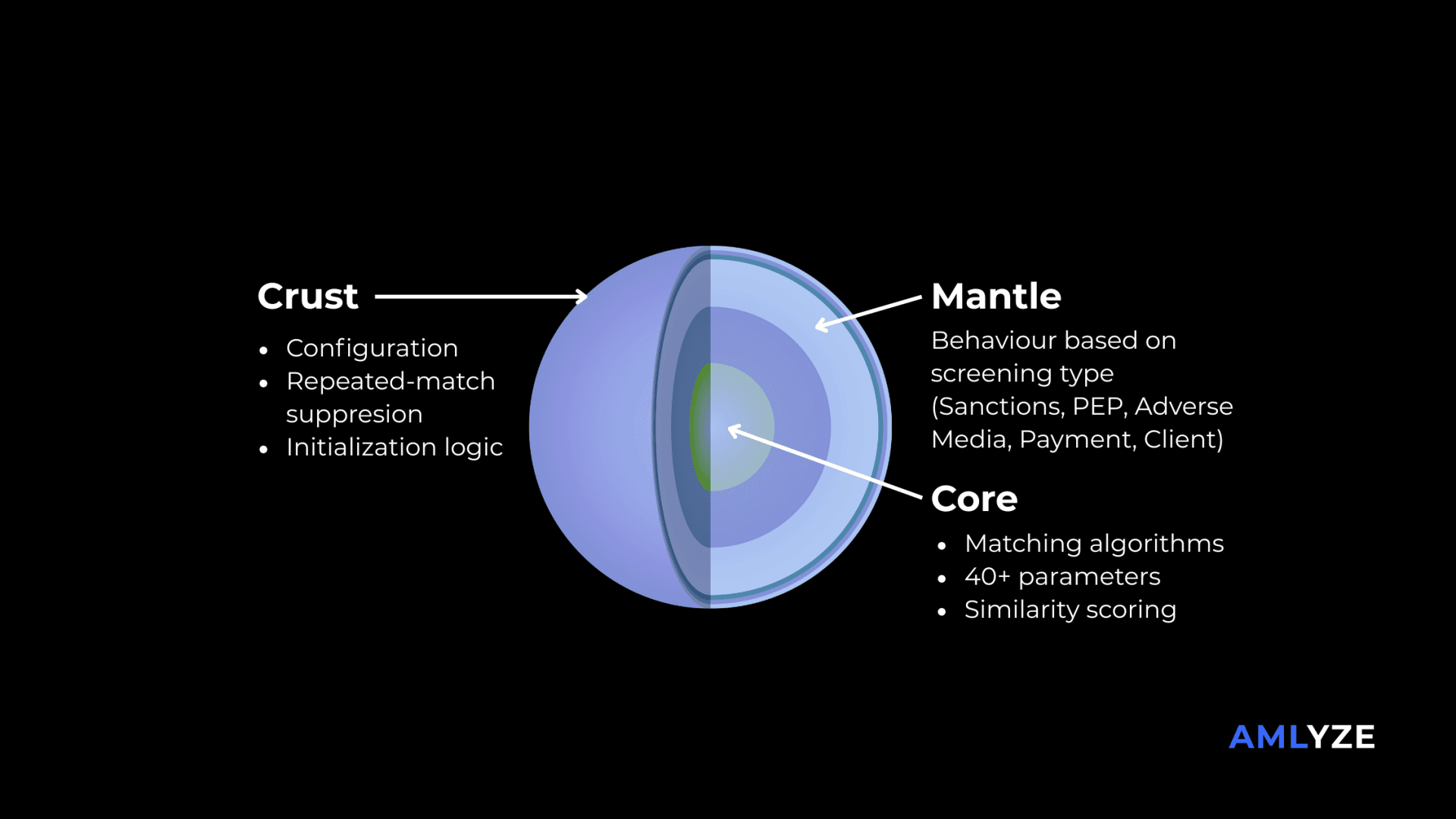 This structure allows the engine to adapt its behaviour for sanctions, PEP, adverse media, counterparty screening, and payment purpose screening – all without compromising detection performance.
How AMLYZE Reduces False Positives
Instead of relying on a single technique, AMLYZE combines multiple mechanisms that work together to improve precision while maintaining strong detection.
Smart Thresholds and Scoring
Most screening systems rely on a single similarity threshold, which limits flexibility. AMLYZE uses a multi-layered approach.
Pre-matching filters remove obvious mismatches early, while word-level and final similarity thresholds ensure only relevant matches proceed to alert generation.
Multiple scoring methods – based on word matches, similarity ratios, and name structure – allow institutions to tune strictness according to their risk appetite.
For structured data such as birthdates, AMLYZE applies intelligent normalization and non-linear scoring. This allows the system to tolerate small formatting differences while still identifying meaningful discrepancies.
Reducing Noise in Name Matching
A large share of false positives comes from weak or overly generic matches.
AMLYZE reduces this noise by:
- Down-weighting common business terms such as “Ltd”, “Group”, or “Trading.”
- Penalizing short or ambiguous tokens (e.g. “Li”, “Al”, initials)
- Handling abbreviations in a controlled way to avoid overmatching
- Allowing institutions to define how aliases, weak aliases, and previous names are used
This ensures that matches are driven by meaningful identifiers rather than accidental overlaps.
Handling Real-World Data Complexity
Screening data is rarely clean or consistent. Names may be split, merged, transliterated, or formatted differently across systems.
AMLYZE addresses this through advanced text normalization:
- Romanization of non-Latin alphabets (e.g. Cyrillic, Greek)
- Removal of diacritics and punctuation
- Flexible handling of spacing and word boundaries
It also detects variations such as:
- “Le Blanc” vs “Leblanc”
- “JohnPeterSmith” vs “John Peter Smith”
By accounting for real-world data inconsistencies, AMLYZE improves true match detection while avoiding unnecessary alerts.
Context-Aware Payment Screening
Payment purpose is one of the highest-risk areas for sanctions evasion, yet many systems treat it as a single block of text.
AMLYZE takes a different approach.
Instead of comparing full sentences, the engine breaks payment data into meaningful word combinations. This allows it to detect relevant entities even when full-text similarity is low.
For example:
“Sending money to Gazprom…”
→ the relevant entity is isolated and matched correctly
This significantly improves detection in complex, unstructured data fields.
Performance Results: Low False Positives, High Accuracy
In controlled, synthetic-data evaluations, AMLYZE demonstrated:
- 99.97% control effectiveness in counterparty screening
- 99.88% effectiveness in payment screening
- False positive rates as low as 0.45%–3.49%
These results reflect performance under tuned configurations and defined test conditions, rather than a universal baseline across all environments.
In practice, outcomes depend on factors such as data quality, screening scope, and institutional risk appetite. However, the results demonstrate what is achievable when screening logic is properly calibrated and optimized.
Real-World Example: VIALET’s 10× Efficiency Lift
VIALET (Via Payments, UAB) evaluated multiple vendors using synthetic data to benchmark screening performance and optimize configuration.
With AMLYZE, they achieved:
- False positive rates of ~0.30%
- An average of ~1.2 alerts per true match
- 10× improvement in operational efficiency
Importantly, this was achieved while maintaining high detection effectiveness (above 99% in standard scenarios and ~97.5% in more complex, manipulated datasets).
What drove these results? A combination of methodical testing and AMLYZE’s configurable engine:
- Pre-matching filtering to drop obvious mismatches fast.
- Tuned thresholds/penalties to match VIALET’s risk appetite.
- Transparent metrics (effectiveness, FP rate, avg. hits) to monitor and optimize.
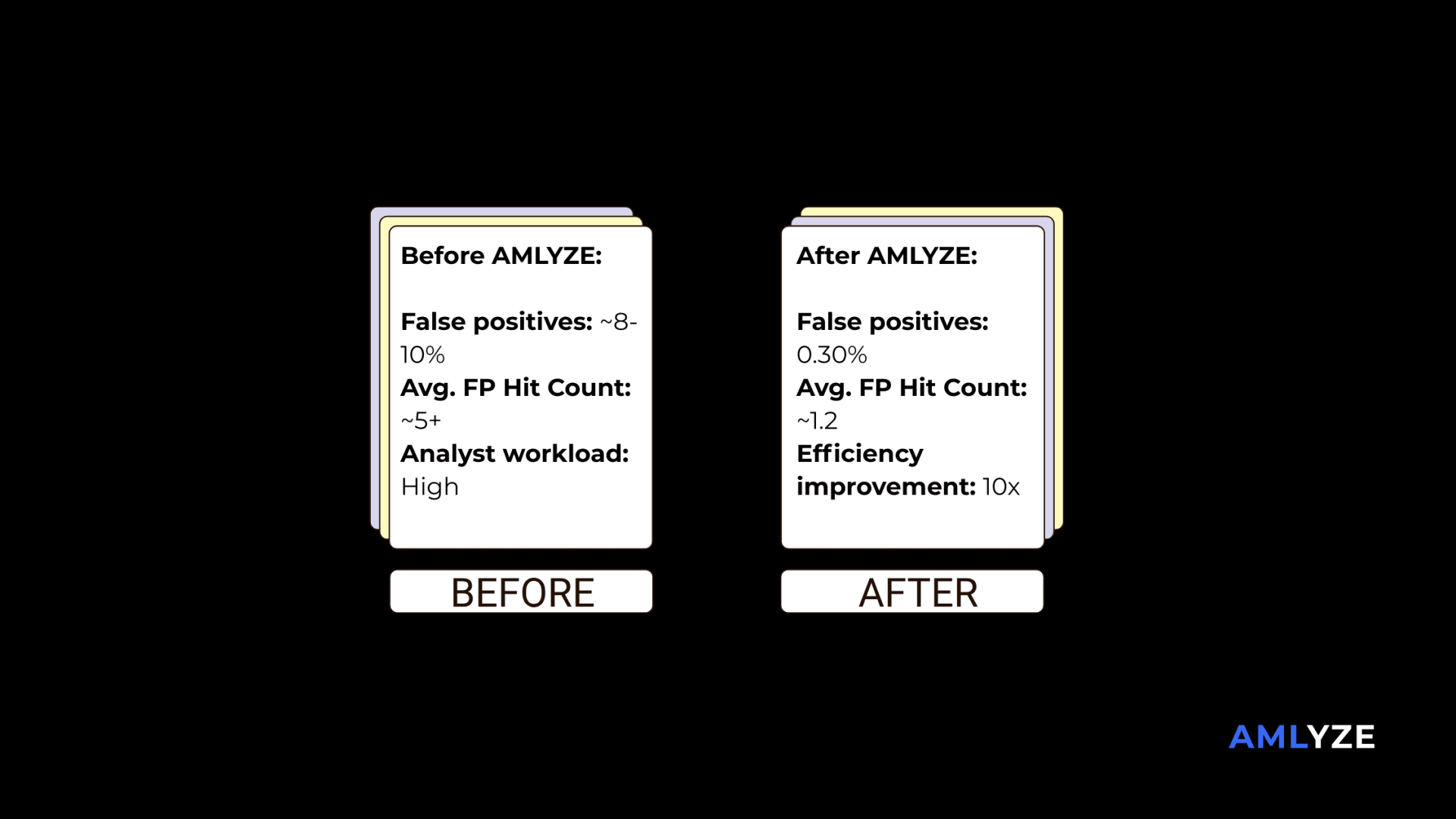
Takeaway: With the right engine and tuning, you don’t need to choose between speed and accuracy.
Why This Matters for AML/CFT Programs
Reducing false positives is not just about efficiency. It directly impacts:
- Analyst productivity
- Customer onboarding speed
- User experience
- Fraud and sanctions risk exposure
- Regulatory outcomes
- Overall cost structure
An engine that generates fewer irrelevant alerts enables teams to focus on true risk – not noise.
Different approach
False positives are unavoidable in screening, but excessive alert volumes are often a symptom of limited or poorly designed matching logic.
AMLYZE approaches screening differently, using precision engineering, regulatory insight, and dozens of algorithmic mechanisms to strengthen detection while reducing noise.
This is what makes AMLYZE one of the most accurate screening engines on the market – and why more institutions are choosing us as their trusted AML/CFT partner.
👉 Explore AMLYZE’s Customer Screening and Payment Screening solutions