
There is one defence that reliably works against money mules, and it is speed. This article is about what speed actually requires, and about the trap inside it. Decision-makers need to understand one thing first: below a certain level of effort, every euro spent on blocking mule accounts quickly is wasted. The criminal business simply takes a thinner margin and carries on. Cross that threshold, however, and the network breaks, with nothing useful in between. And the threshold can only be reached when institutions act together. An account blocked at one institution and reopened at another has not been stopped at all.
This is the third of four articles (read last one Article 2 here) on the economics of fighting fraud on instant payment rails, published alongside Eglė Kontautaitė’s series on the PSR. Article 1 showed why the institution that receives stolen money stops tightening its controls long before most of the fraud is caught: it bears the cost of every false alarm and almost none of the loss. Article 2 showed that the supply of mule accounts cannot be priced away. The only intervention that makes the criminal business stop being profitable is blocking the account within hours of the first suspicious payment, funded properly. In seven steps, I take that intervention apart, from how it works to the legal shape it has to take.
1. The mechanics: stopping an account means three things, and detection alone is not enough
Rapid interdiction sounds technical, but the idea is simple and has three parts. First, the institution detects that an account is receiving stolen money. Second, it freezes the account within hours, not days. Third, the person behind the account is stopped from opening a new one elsewhere, and if they already have, the institutions holding those accounts are told. All three are needed, and an alert that waits in a queue for an analyst adds nothing: this is an intervention, not a detection programme.
Stopping an account does not mean closing it. A block is much faster than a closure and can be undone, and nobody has to decide yet whether to keep the customer. As step 6 shows, that distinction matters for the law, and the rule that follows is simple: block first, decide later.
The approach works because it hits the criminal business from both sides at once. As Article 2 explained, mule accounts are bought and sold like any other asset. A laundering operation buys them at the market price and uses each one for a payment or two before it is caught. Cut the value an account can move before it is blocked, and two things happen. Each account now earns less, so the operation can afford to pay less for it. It also needs more accounts to move the same money, which pushes it up the supply curve, where each extra recruit costs more. The yield falls while the number of accounts needed rises, and the unit economics break: an account costs more to acquire than it brings in.
In euro terms, using the proxy prices from Article 2, a typical account that receives two payments brings the operation about EUR 1,700 before it is stopped today. If fast blocking removes 90% of that value, the account brings in only about EUR 170. The operation then needs ten times as many accounts to launder the same amount, and it pays more for each of them. At that point, the business can no longer cover its costs.
In the model, the operation collapses when fast blocking removes about 90% of what an account would otherwise deliver with today’s typical controls. With a strong control stack already in place, the threshold falls to about three quarters. The most common pattern is an account that receives two payments over a couple of days. For that pattern, reaching the threshold means containing the account within a handful of hours of the first payment, before the second one can be passed on.
Past the threshold, a second effect kicks in: accounts are burned faster than recruiters can replace them. In the model, when 85% of an account’s value is removed, the operation can find only about one in six of the accounts it needs. It then spends about 80% of its time unable to work, because it has nowhere to receive money.
Clearly, the tactic works. The critical question is what happens before that breaking point, and the answer is the uncomfortable part of this analysis.
2. The efficiency trap: why partial effort is worse than none
The temptation is obvious: aim lower, spend less and take some of the benefit. There is no partial benefit to take.
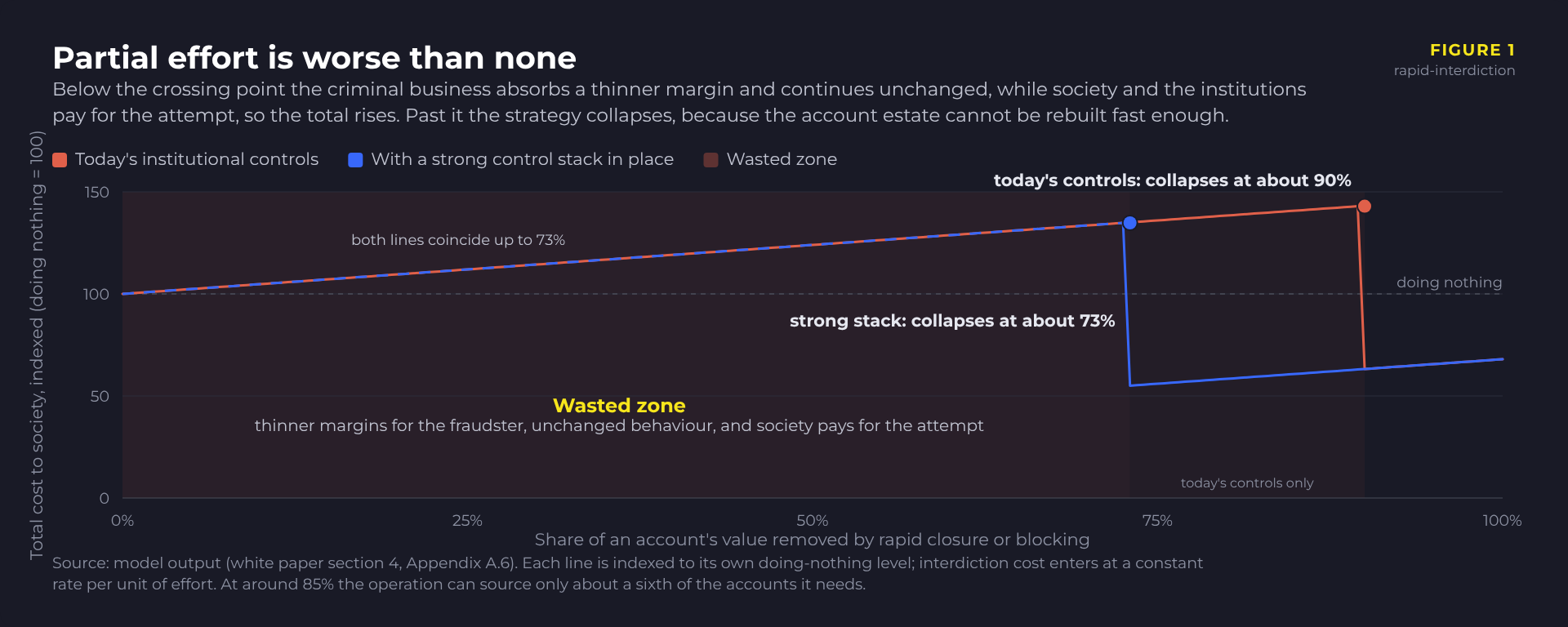 Figure 1. Partial effort is worse than none.[1] Total cost to society, indexed so that doing nothing equals 100, against the share of an account’s value removed by fast blocking. The criminal operation collapses at about 73% of value removed with a strong control stack, and at about 90% with today’s typical controls.
Read the chart from left to right. While blocking effort stays below the threshold, the total cost to society rises with it. Money is being spent, yet fraud losses do not fall. The criminal’s margin gets thinner, but not thin enough to make them stop, so the victims lose what they lost before. The shaded area is the wasted zone, where every euro spent trims criminal profits and protects no one. Once the threshold is crossed, the line drops sharply: the business stops being profitable, the mule network cannot be refilled fast enough, and fraud losses all but vanish. Article 2 showed the two sides of this threshold as two bars, an index of 129 below it and 63 above it. This chart shows the ground in between, and it holds nothing but cost.
This runs against normal investment logic, and economists have a name for it: a threshold effect. The usual instinct, especially with public money, is to start small, measure the effect and scale up what works, but here that approach is bound to fail. A programme that never crosses the threshold shows no fall in fraud, so it is judged a failure and cut after burning money for nothing. There are only two sensible options: fund it well enough to clear the bar, or do not start.
The threshold is a clock, and only machine speed beats it, with people stepping in only to confirm or release a block. An institution that takes two days to get from alert to block sits in the wasted zone, however good its detection rate. So does an institution that blocks within an hour but cannot stop the same person opening a new account across the street. That second condition is where any single institution hits a dead end.
Machine speed is also what makes blocking affordable. As Article 1 showed, the biggest cost of a false alarm is not the analyst’s time but the honest customer’s money, held still while the check runs. Cut that holding time tenfold, and an institution can afford to flag about seven times as many accounts at the same cost. A block applied in seconds can be lifted within a minute, for example once the customer confirms who they are in the app. Such a block barely touches an honest customer and kills a mule account. The engineering that beats the threshold is the same engineering that protects the customer experience.
3. The isolation penalty: why standalone efforts net just twenty-six cents per euro
Run by a single institution, rapid interdiction is a weak business case. In the model its benefits come to about 1.3 times its cost, which means twenty-six cents of net benefit for every euro spent. Because the system has to be paid for up front, it also competes for budget with commercial projects that pay back faster and more.
Two things keep the return this low. The first, set out in Article 1, is a mismatch of incentives: the institution that pays for blocking is rarely the one that would bear the loss. Most of the benefit therefore goes to the victims and the sending institutions rather than to the one that paid. The second is displacement. Article 1 found that an institution tightening its controls alone removes at most a third of the fraud across the system. The rest moves to competitors with softer defences. A recruit whose account is blocked simply opens a new one elsewhere, so the blocking institution has paid for the block, and the system has bought a delay, not a solution.
A finance director who sees a benefit-cost ratio of 1.3 and turns the request down is therefore not being short-sighted. That needs saying plainly, because the usual answer of regulators and the industry to weak investment in fraud prevention is to ask institutions to care more. The numbers show that appeals of that kind will not work, and that to break the criminal business, the system itself has to change.
4. The network effect: how collective action triples the benefit of every euro spent
Rapid interdiction differs from other fraud controls in a way that is the heart of the strategy. Prosecutions are paid for case by case, and each institution’s own controls are paid for separately and mostly push the problem next door. A shared blocking layer, by contrast, is fixed infrastructure. It blocks an account and stops the same person opening new ones at every member at once. Its benefit therefore covers the whole system, and criminals cannot route around it.
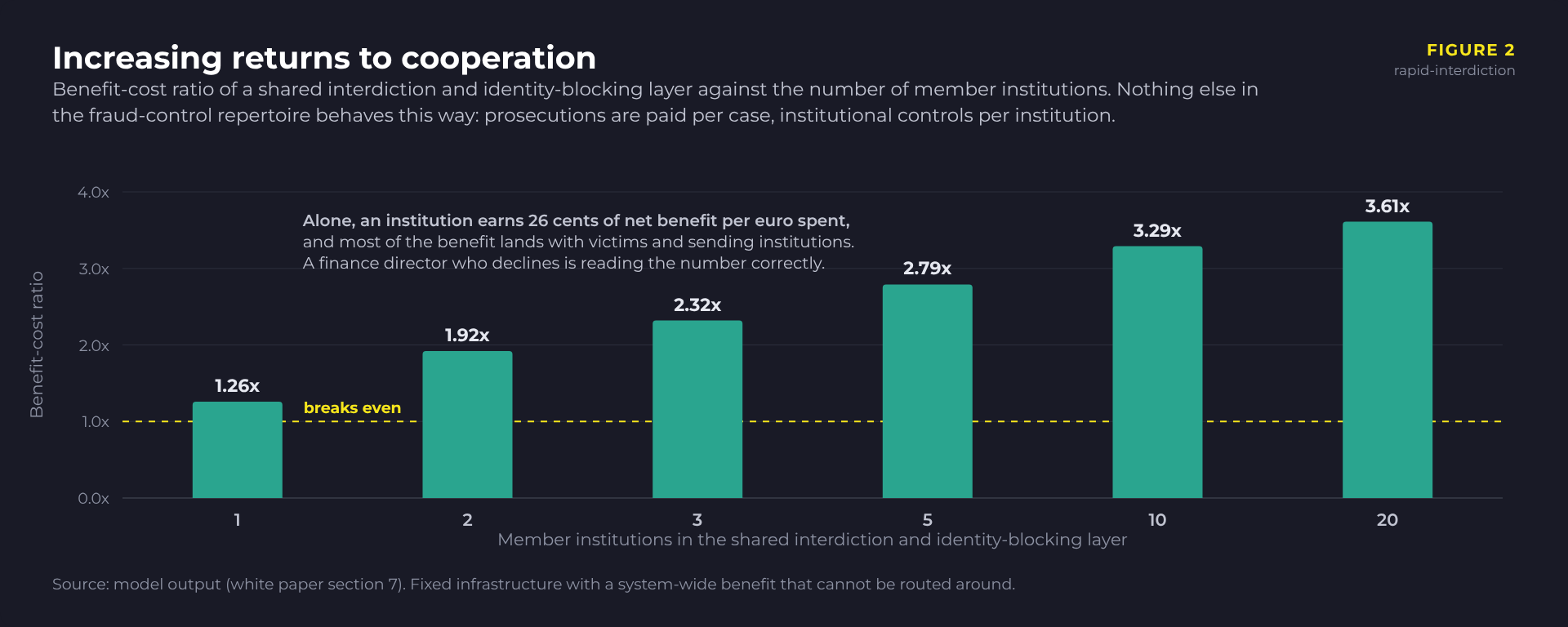 Figure 2. Increasing returns to cooperation. The benefit-cost ratio of a shared blocking layer against the number of members: about 1.3x for one institution alone, 1.9x for two, 2.3x for three, 2.8x for five, 3.3x for ten and 3.6x for twenty. No other fraud control in the model behaves this way.
The rising curve comes from the economics of recruitment. As Article 1 showed, a criminal who pays EUR 50 for a recruit is not buying one account but a foothold at every institution willing to onboard that person. If five institutions accept the recruit, the criminal gets five account lives for one EUR 50 fee, an acquisition cost of just EUR 10 per account.
When those institutions share closures and block that person, the criminal is back to one recruit, one account life and EUR 50 an account. Each new member takes another account life away from the same recruit. It also shortens the lives that remain, because the closure signal reaches the other members at once, before the money moves on. Each new member therefore raises the return for all the others, which is what economists call a network effect. From one member to twenty, the benefit-cost ratio roughly triples. Put as net return, each euro spent goes from earning about 26 cents to about EUR 2.60, a tenfold rise.
In economic terms, this is a positive externality: each institution that blocks and shares creates benefits that land elsewhere. Private returns are thin while the shared return is several times higher, so no single institution gains enough to fund the system alone. Each has a reason to wait for the others to build it, which is the classic free-rider problem. Market failures of this kind are why shared utilities and public policy exist. The sector should build the system once rather than twenty times. Every receiving institution must take part, because any institution left outside becomes the soft target the layer exists to remove.
The only published data shows how far current practice is from this. Twenty-five UK firms offboarded 194,084 suspected money mules between January 2022 and September 2023 but reported only 37% of them to the national fraud database, and one firm reported just 6%.[2] Nearly two thirds of those closures therefore left no warning for the next institution, and those recruits were free to open accounts elsewhere.
If the layer has to be shared, the next question is what should flow through it.
5. Beyond identity: sharing signals that survive a burned name
Sharing identities is the right place to start, but it is not enough on its own.
The first thing worth sharing is not a case file but a simple count, which I call onboarding velocity. It measures how many institutions have onboarded the same verified person, and how recently. A recruited mule often opens more than one account, because the mule herders who run them want accounts at several institutions. Ordinary customers do not open ten accounts in a fortnight, so a person who does is a stronger warning sign than most monitoring alerts. The count needs only identity data, no behavioural data, yet nobody can see it today because each institution sees only its own onboarding. Technically, a hashed identity and a counter would be enough.
The second tier is harder, and it is where the coming law risks a serious mistake. In organised crime a name is the weakest signal, because fake or stolen names are cheap to replace. What lasts longer is the set of tools behind them, such as devices, email addresses and phone numbers, which often survive a change of name. The coming Payment Services Regulation (PSR) will make taking part in fraud data sharing mandatory, which is right in principle. Institutions will have to exchange data where it is needed for their monitoring and there are objectively justified reasons to suspect fraud.[3] Only a short list of data may be shared, however, and the list expressly leaves out the payer’s environmental and behavioural characteristics, the category where device data sits. Yet the same law requires institutions to use those very characteristics in their own monitoring. The strongest data is therefore used inside every institution and shared between none.
As drafted, the law will mandate sharing the weakest signals while locking away the strongest, a flaw that should be fixed before it applies. The new Anti-Money Laundering Regulation (AMLR) offers a narrower route from July 2027. Its information-sharing partnerships could carry device and behavioural data as risk factors. They may do so only for customers already seen as higher risk, or where more information is needed to judge the risk. Members must also notify the supervisor in advance, assess the data protection impact, keep a person in charge of automated output and never decide on a partner’s data alone.[4] It is a useful route, not a substitute for fixing the PSR.
Whatever flows through the layer, one rule about its use is not negotiable, and it is the subject of the next step.
6. The legal pathway: from shared signal to restricted account, never an automatic decline
A shared blocklist can never lawfully work as an automatic bar. In a June 2026 ruling,[5] the European Court of Justice held that being on such a list is a relevant risk factor but never, on its own, a ground for refusing a customer. Refusal is lawful only when proportionate steps, such as ongoing monitoring, cannot manage the risk. The case concerned a third-country sanctions list, but the reasoning does not depend on the type of list. If anything, it applies with more force to a private blocklist, which has no basis in law and no due-process safeguards. The EU rules on access to a basic payment account point the same way.
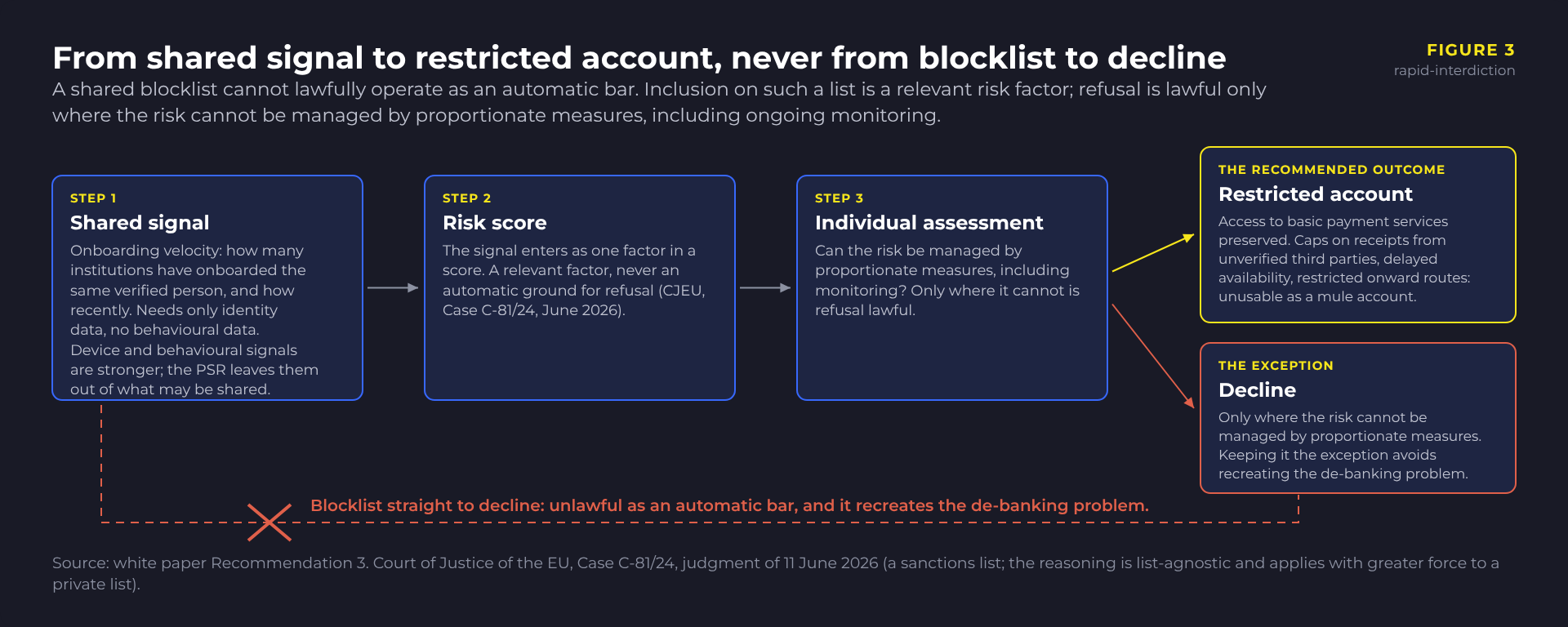 Figure 3. From shared signal to restricted account, never from blocklist to decline. The lawful path, with a restricted account as the default and outright decline as the last resort.
The lawful design therefore runs from shared signal, to risk score, to individual assessment, and never from blocklist straight to decline. That constraint points to a better answer than refusal: the restricted account. With it, the person keeps basic payment services while the account loses its criminal use. Targeted limits achieve this: caps on incoming transfers from unverified third parties, delays before incoming funds can be used, and limits on onward payments. A mule account exists to receive money from strangers and pass it on fast. Once those two abilities are gone, it is worthless to the criminals, while the holder can still be paid a salary and pay the rent. Like a block, the limits can be applied at machine speed and lifted later without ending the relationship. The design balances financial inclusion with fraud disruption, and it avoids recreating the de-banking problem that has already needed regulatory action in several markets.
7. The credit event: why interdiction must come before the customer is credited
There is a large and little-noticed difference between stopping a payment on its way out and refusing one on its way in. Under the coming PSR, a receiving institution with objectively justified reasons to suspect fraud may decide not to make the funds available to its customer and to return them to the payer’s institution. Where the reasons are clear and incontrovertible, it must do so, and it carries the burden of proving that it complied.[6] Timing matters, though. The power covers money credited, or about to be credited, to the institution’s own account, and the decision has to be taken within the normal crediting timeline, which for an instant payment is a matter of seconds. Once the customer’s account has been credited, the power to reverse the payment becomes narrow and legally unclear, neither a clear “you can” nor a clear “you cannot”.
National guidance shows the problem after the credit. The Bank of Lithuania’s fraud prevention guidelines let an institution and its customer agree in advance on a way to debit credited funds if the paying institution reports fraud. The guidance is not binding, however. It tells the institution to ask for the customer’s consent again at the moment of the debit, even if consent was given before. It also makes the institution liable for the customer’s losses if the debit is later judged unreasonable.[7] The route therefore rests on a contract rather than a statute, with the whole legal and financial risk sitting with the institution that acts. No institution will use a power like that at scale, and only a clear statute can close the gap. Lithuania has since proposed one, a right to debit funds obtained by fraud and return them to the victim, which was put to public consultation in May 2026.[8] The proposal itself admits that the power does not exist today.
Apart from that narrow contractual route, every tool available today is a freeze rather than a return. Anti-money-laundering (AML) suspensions expire, after which the money goes back to the account holder. Payment scheme recall rules, for their part, make the beneficiary’s refusal to return the money final. The window for action is therefore measured in seconds, not days. Investment should go into automated blocking before the credit rather than into recovery afterwards. That will remain true until a law allows returns after the credit and protects institutions acting in good faith.
This shift has a reporting consequence. A fraudulent payment rejected before it is credited never shows up in an institution’s fraud rate, because it counts neither as a loss nor as volume. A preventive control that works perfectly is therefore invisible in every figure reported today, and that should change. There is one catch: if a daily limit rejects a payment on Monday and the same payment goes through on Tuesday, the institution records a prevention while the criminal has only waited a day. Institutions should therefore match and remove repeat attempts, meaning the same payer, payee and amount within forty-eight hours.
Also read:
Money mule economics: why the receiving institution underinvests in stopping fraud
Money mule prevention: why you cannot price mules out of the market
Recommendations from this analysis[9]
- Fund interdiction programmes to clear the threshold, or defund them. Below the threshold, partial interdiction costs society more than doing nothing. The bar is measured in hours, and every member institution has to meet it at the same time.
- Build cross-institutional identity blocking as shared infrastructure, with a lawful route to a restricted account. Start with verified identities and onboarding velocity, then extend to device, email and phone data, and change the PSR’s sharing rules so that this is allowed. Shared signals should feed a risk score and an individual assessment, with a restricted account as the default outcome.
- Give returns after the credit a legal basis, and count what is stopped before it. The law should let institutions return fraudulent funds that have already been credited, and it should protect those acting in good faith. Payments rejected before the credit should count in fraud reporting, net of the same payment going through within forty-eight hours.
- Require outcomes to be evidenced, but do not publish the exact thresholds. Professional laundering syndicates charge a percentage fee and repay their clients for frozen funds, so their income is capped while their liability is not. In effect they sell insurance, and an insurer is hurt not only by high losses but by unpredictable ones, because it cannot price a risk it cannot forecast. In the model, a regime with the same average freeze rate but much wider swings tightened the capital constraint on such a syndicate more than tenfold. Regulators should therefore require the outcome and evidence of it, and leave institutions to reach it their own way. A defence whose thresholds are published is a defence criminals will design around.
What this means in practice
For a receiving institution, three things follow.
- Measure containment in hours. Track the time from the first suspicious payment to the block. If your process cannot block within a handful of hours at machine speed, you are below the threshold, whatever your detection rate says.
- Share every closure, and never decline on a shared signal alone. What you send protects other institutions, and what you receive should feed your own risk score and an individual assessment.
- Get your return-of-funds route checked before you rely on it. If it rests on prior consent under non-binding guidance, the liability is yours, so settle it with Legal and Compliance before you design the process.
Notes and sources
[1] Model output, not observed losses; see the note to “Recommendations from this analysis”. The crossing points come from a synthetic portfolio and are illustrative; the shape of the curve is the finding.
[2] Financial Conduct Authority, “Firms’ use of the National Fraud Database and money mule account detection tools”, January 2025: 194,084 money mules offboarded by twenty-five firms between January 2022 and September 2023, of which 37% were reported to the National Fraud Database; the 6% figure is the lowest-reporting firm in the sample.
[3] Council of the European Union, compromise text of the proposed Payment Services Regulation, ST 8221/26 of 17 April 2026 (revised text ST 8543/26 of 21 October 2026). The data that may be exchanged covers the suspected fraudulent behaviour, the account or transaction concerned and the reasons for suspicion; the environmental and behavioural characteristics of the payer are expressly excluded. See Judith Arnal, “Sharing Fraud Intelligence under the Payment Services Regulation: Mind the Gap”, ECRI In-Depth Analysis, CEPS, August 2026. Not yet in force; expected to apply from late 2028.
[4] Regulation (EU) 2024/1624, Article 75, applicable from 10 July 2027. Sharing must be strictly necessary for customer due diligence or suspicion reporting. AMLA and the European Data Protection Board announced joint guidelines on 1 July 2026.
[5] Court of Justice of the European Union, Case C-81/24, LH v OTP banka d.d., judgment of 11 June 2026.
[6] Payment Services Regulation, compromise text cited in note 3, Article 69(2a) and recital 90a. The provision refers to funds credited or to be credited to the account of the payee’s payment service provider, not to the customer’s account.
[7] Bank of Lithuania, Fraud Prevention Guidelines, decision of the Financial Market Supervision Committee No V 2024/(1.160.E-9004)-441-16 of 16 January 2024, in force 1 May 2024, paragraphs 55 to 60. The Guidelines state that they are not an official interpretation of the law and use “should” rather than “must” throughout.
[8] Government of Lithuania, release of 25 February 2026, and Ministry of Finance public consultation of 8 May 2026: providers would be able to freeze funds on reasonable suspicion of fraud and, where fraud is confirmed, debit them from the payee’s account and return them to the victim without a court order. A draft, not adopted at the time of writing.
[9] Every figure in this series is the output of a simulation that runs a criminal operation, described by attack patterns drawn from real-life cases and typologies, against a representative electronic money institution, and compares two runs that differ in exactly one thing. Interdiction enters the model as a shortening of account life, with its cost at a constant rate per unit of effort. The total cost to society adds victim losses, the cost of institutional controls including friction, the cost of enforcement and the harm done to recruited people when they are prosecuted. Results are ratios and multiples under stated assumptions, not observed losses. How the model is built, and every assumed parameter, are set out in Appendices A and B of the white paper, which will be available at the end of the series.
This article reflects the author’s own analysis and views. It is provided for information only and does not constitute legal advice.