Regulators no longer take a vendor’s word that sanctions screening works. They test it, and the results show a clear pattern: exact names are caught, slightly altered ones often are not. This article explains how synthetic sanctions screening testing measures the gap, what it means for EBA compliance, and how to use the results with your vendor.
In May 2026 the UK Financial Conduct Authority published what it found in a review of more than 150 companies. In its own screening tests, systems identified the sanctioned party in 90% of cases where the name was spelled exactly as on the list, and in 75% where it was spelled slightly differently. One altered name in four went through unflagged.
Sweden’s Finansinspektionen reported the same in November 2024 at 19 banks: customer screening found 86% of names as listed and 64% with a change. EU rules point the same way. The EBA guidelines on restrictive measures, in force since 30 December 2025, ask banks, payment and e-money institutions to test their matching regularly and to write down why the settings are what they are. From 10 July 2027 targeted financial sanctions controls move under the EU AML Regulation, with AMLA behind it.
Production alerts alone cannot justify parameters. They show what the engine caught and nothing about what it missed. The direct way to get the missing number is a test where the right answer is known before the file is screened. That is synthetic testing, and the rest of this article is about what it gives you.
The method, briefly
Every test consists of three kinds of records. Control records are real list entries, copied as they appear on the sanctions lists, and every one must be flagged. Manipulated records are copies of the controls with one deliberate change each, and every one must be flagged too. Fabricated records are invented names that resemble a listed one but belong to nobody on any list, and none should be flagged.
The changes imitate the three ways a name drifts from its list entry. Honest error: a keyboard-neighbour typo, a dropped or doubled letter, a date keyed with day and month swapped. The same name is written differently: transliterated, a first name reduced to an initial, surname first, “Limited” instead of “Ltd”, a title in front, an alias. Deliberate evasion: a symbol inserted, words joined, a name part or the legal form dropped. One change per record, so every miss has a known cause.
The testing is not built around any one engine. The changes come from how names get mangled in KYC and payment data, so the same test can be carried out on any system, at any size, and run again a month later with the two results compared like for like. We run the same file on our own Screening module after every change to its matching logic.
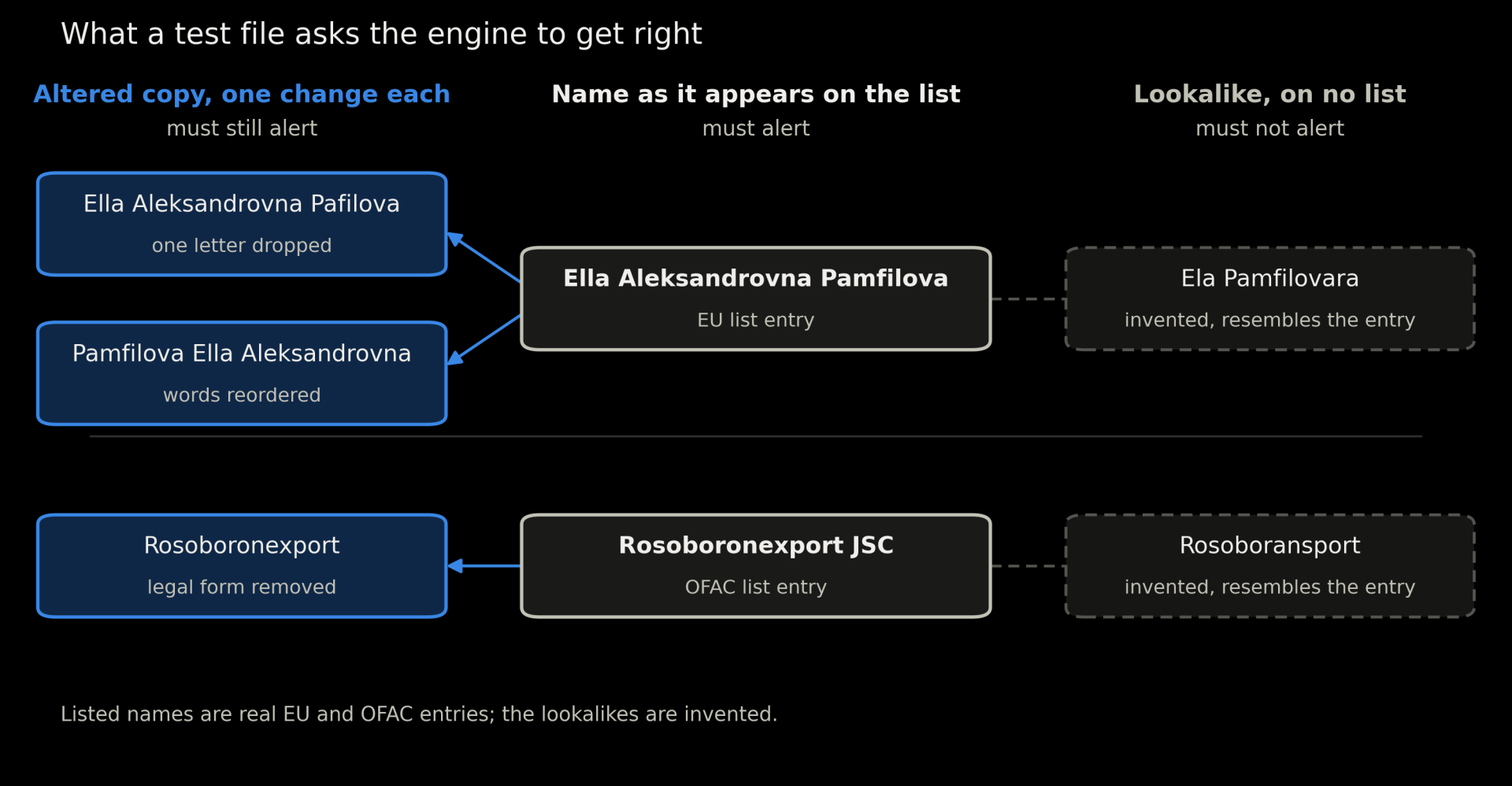
Figure 1. One list entry, the altered copies that must still alert, and the lookalike that must not. The listed names are real EU and OFAC entries; the lookalike is invented.
During an exercise the testing file is built and screened on the same day to avoid list misalignment due to frequent updates. The testing is finished with a written report containing evidence to support findings. For instance, each kind of change to entity data is shown and how many of the altered names were found, and alongside it how many fabricated names were flagged by mistake. This holistic comparison pinpoints vulnerabilities and narrows down list of required improvements: the vendor knows which kind of change to work on, and the retest shows whether it worked. Clients may use the report in three ways: preparing for the regulator’s test, finding weak spots and proving a fix, and choosing or switching a provider.
Preparing for the regulator’s test
The FCA reports what its testing uncovered. A “Mr” or “Ltd” attached to a name was enough for some systems to fail to flag a person or company as sanctioned. At some companies, names of one word, or containing a digit, were excluded from screening by default. Names longer than a field limit were cut off and passed through without a warning. Some companies could not catch a variant spelling or a name written in a non-Latin alphabet. And several had never tested their screening themselves; they had the vendor’s word that it worked. Good practice, in the same report, was to retest with the vendor after every major update or change to the matching logic.
The EBA guidelines say what the testing has to cover: the matching settings, checked by how detection moves as the threshold moves; the lists, whether they are current and complete; and the scope, whether every customer and every transfer is actually screened. The reasons for the chosen settings have to be written down and ready for the supervisor.
A synthetic file reproduces each of those failures on purpose, so the company sees them before the regulator does.
| What regulators found | What the test file contains |
| A title or legal form in the name pushed the score below the alert line | Listed names with Mr, Dr, Jr or a legal form attached, and copies with them removed. A miss on either version is the finding. |
| One-word names and names with digits were excluded from screening by default | Listed names that are a single word, and copies where a letter is replaced with a look-alike digit (0 for O, 1 for l). |
| Long names were cut off without an alert | Listed names as long as, and longer than, the usual field limits, so a silent cut-off shows up as a miss. |
| Variant spellings missed | Copies with one letter changed, dropped, doubled or swapped. |
| Altered names caught far less often than exact ones | Every kind of change scored on its own row, so the company sees which changes it misses, not only that it misses some. |
| Non-Latin names missed | Names transliterated from Cyrillic or Arabic, and names with look-alike letters from another alphabet. |
| Reliance on the vendor’s assurance | A dated result table the company can read and keep without the vendor in the room. |
Table 2. What regulators found, and what in the file would have shown it.
The obligation to validate screening stays with the regulated institution, whatever the vendor promises. The result table is the company’s own evidence that it did.
Finding the weak spots and proving the fix
The result table says which kinds of change the system misses. It does not say how to fix them; that belongs to whoever owns the engine. What it gives the company is a narrow instruction for the vendor and a way to check the answer. The example below is what a first run typically looks like on any engine, and what the same rows look like after one fix. The figures are illustrative.
| Kind of change | Altered names found, first run | After the fix |
| Two neighbouring letters swapped | 93% | 94% |
| Words reordered | 95% | 95% |
| Legal form or title removed | 65% | 93% |
| Fabricated names flagged by mistake | 10 in 1,000 | 11 in 1,000 |
Table 3. Three kinds of change, same file, before and after a fix.
Two rows were fine from the start. The third says that when “Rosoboronexport JSC” arrives as “Rosoboronexport”, a third of the time nothing happens. That is one instruction for the vendor: teach the engine that “JSC”, “Ltd” and “Mr” are not part of the name. Lowering the match threshold instead would have repaired the row and raised false alerts on every record in production. After the change the same file runs again. The third row moves from 65% to 93%, the other two stay where they were, and the false alerts rise from 10 to 11 in 1,000, which is the price of the change and is now known rather than guessed. Every later change gets the same treatment: same file, same table, and the second table is the proof either way.
Choosing or switching a screening provider
Vendors tend to demonstrate system performance using names their systems handle well. The way around that is to send a large number of randomly selected records within the testing file and require file execution and return of results on the same day. The file is built in each system’s input format, so each engine faces the same names, the same typos, and the same fabricated records.
| Engine A | Engine B | |
| Listed names found | 98% | 100% |
| Found after one letter changed | 25% | 95% |
| Found after a whole word changed or dropped | 97% | 93% |
| Found after transliteration | 100% | 99% |
| Found after legal form or title removed | 99% | 85% |
| Fabricated names flagged by mistake | 25 in 1,000 | 35 in 1,000 |
Table 4. Two engines, same file, same day. Illustrative figures, shaped on the pattern we see across comparisons.
Read across the rows. Engine A copes with a missing or changed word and misses three single-letter typos in four. Engine B is the other way round, and weaker on legal forms. Engine A also raises fewer false alerts, which matters because it inflates the backlog. Which one fits depends on the traffic: a payment institution paying mostly companies cares about the legal-form row, a bank with names typed in by branch staff about the single-letter row.
The same file answers the migration question. Run it on the old engine before the switch and on the new one after, and “did we lose anything” has a number per kind of change instead of an opinion.
What the client walks away with
Testing provides measurable evidence that can be used in three ways:
- Demonstrate screening effectiveness. Dated results for each sanctions list, with actual name counts behind every percentage, provide evidence for regulatory reviews. The results also highlight configuration failures that standard accuracy metrics may overlook.
- Identify and measure improvements. Testing reveals where names are missed, excluded, or truncated. Repeating the same test after configuration changes shows exactly how detection rates and false positives are affected.
- Make informed vendor decisions. Testing different screening engines with identical inputs allows organisations to compare their performance consistently before selecting or migrating to a provider.
None of these activities requires production data to leave the company.
Find out what your screening misses before the regulator does.
We build the test file, you screen it on your own system, and you get a dated result table for every kind of change, with no production data leaving your company.